

Future City Berlin: New Ideas from the Capital
10 tips on how to experience the future in Berlin today
A ride through the city in an autonomous taxi: in Berlin, this isn’t a vision for the future, but already a reality. At Berlin’s research centres, you can gain an insight into a wide range of new technologies where innovation and artificial intelligence come together.
These are already being implemented in experimental art formats, as well as in the dining scene. Let Germany’s first female sales robot, Gisela, serve you. Or how about an ice cream made with liquid nitrogen, chilled to -196°C?
You can experience historical moments first-hand during your city discovery tour using AR and VR. And with a wide variety of event formats, urban labs, tech fairs and, of course, the Futurium, the future becomes an immediate experience. Try out new technologies, join in the discussion and be inspired.
Like all major cities, Berlin must face the major challenges of our time. Join us in discovering established projects and visiting places where new ideas are being generated and innovative concepts developed.
Tip 1: Futurium Berlin – And how do you see the future?

Through various thematic sections, the exhibition at Berlin’s Futurium invites you to reflect on the future. How will we live together in cities in the future? How will we get around? What will we eat? How will we define justice in the future? The latest information on the major issues of our time – such as climate change, artificial intelligence and new forms of society – is presented in an entertaining and inspiring way. The exhibition, featuring numerous multimedia and interactive elements, has been awarded the European Museum Prize. “Every country should have its own Futurium,” said the jury. In the Futurium Lab, you can get hands-on. A journey into the future that is also ideal for families.
Since May 2025, there has also been a green installation outside the Futurium. The installation is a living system at the intersection of art and science and forms part of the new exhibition “Fields of the Future”. It explores innovative solutions for the agricultural sector in relation to ecosystems, biodiversity and climate change.
In our Berlin Unboxed podcast, we explore possible future models with Gabriele Zipf, Head of Exhibitions, and Verena Bischoff, Education Officer at Futurium. Because there is no single future. Have a listen!
Tip 2: Discover the future in Berlin with children

Other exciting places for children interested in the future and technology include the Computer Game Museum, which showcases not only nerdy retro games but also exciting interactive and innovative technologies. At the Science Center Spectrum run by the German Museum of Technology Foundation, kids can build robots. And at the FEZ Space Club, kids and teens can train in orbit just like real astronauts. By the way: Berlin’s Technical University and several start-ups already have numerous satellites in orbit.
In the AI Experience Room at the German Museum of Technology, you can chat with AI-based language models, look inside the human body using mixed-reality glasses, and learn all about the use of artificial intelligence in everyday life and the workplace
Tip: The HABA Digital Workshop and the Hacker School offer workshops that teach future-oriented skills to kids. You can find the dates and locations of the next workshops on the providers’ websites. Some gaming start-ups, such as Wooga, also regularly run workshops for kids and teens, demonstrating that learning for the future can be really fun. Please check directly with the providers for details.
At the Computer Games Museum , you can play with technologies and computer programmes that once sounded like pure science fiction.
And at the Museum of Communication, children go on a robot rally with the museum robot MR4 and the digital pet Katzomat. On a wild hunt for C-Bot, the little futurists learn lots of interesting facts about the history and future of communication using augmented reality technology.
And even more robots in Berlin

With the sales robot Gisela, the Berlin-based company Robots&Girls presents Germany’s first humanoid sales robot. In the retail Garage in the basement of The Playce, Gisela demonstrates what the retail of tomorrow looks like – fully automated, interactive and surprisingly charming. Visitors can watch live as she assembles and sells small cardboard toybots. These clever mini-robots later serve as customisable holders for pens, photos or business cards. The retail Garage is open daily until 11 pm – a glimpse into the future right in the heart of Berlin.
In total, over 60 companies are conducting research in the field of robotics in Berlin, including leading technology firms such as Gestalt Robotics, Klero and pi4_robotics, the parent company of Robots&Girls and Gisela.
Tip 3: Innovative exhibition concepts and digital offerings

When art and technology come together, entirely new creative possibilities emerge. Pioneers in Berlin include Dark Matter and the LAS (Light Art Space). All three offer innovative, technology-driven art experiences where you can fully immerse yourself in worlds of light, sound and space.
Anyone interested in digital art will find what they’re looking for at the Julia Stoschek Foundation . With HAU 4, the Hebbel am Ufer has established a digital stage for projects created specifically for virtual reality, digital or hybrid spaces.

And the world’s first and, to date, largest NFT marketplace is also based in Berlin. On OpenSea, the art of the future is traded digitally via non-fungible tokens (NFTs).
Anyone wishing to explore Berlin’s history and stories will find a new dimension to city tours in virtual reality and augmented reality offerings . It is fascinating that many innovative experiential worlds are finding the perfect venues in old industrial buildings, such as the Kraftwerk. You can find further immersive exhibitions and attractions where the boundaries between digital and real-world experiences blur here.
Tip 4: Actively shaping the city: Urban practice in Berlin
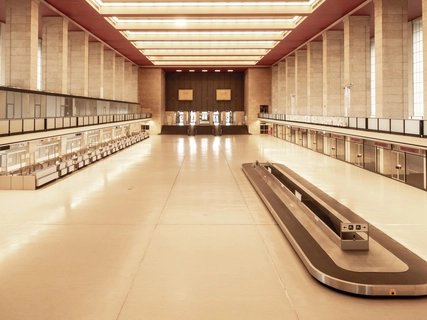
Berlin without building sites still seems like a distant vision of the future. And yet it is precisely this constant change that creates plenty of scope for creativity and new ideas. You can get a glimpse of this at the Holzmarkt, the RAW site, in the hangars at the former Tempelhof Airport, or in the pilot project Haus der Statistik on Alexanderplatz (Otto-Braun-Straße 70). Originally, the former administrative building of the GDR was to be demolished. Now, civil society and the public sector are jointly planning the development of the site.
Various initiatives have set up shop in the building itself, foremost among them the Haus der Materialisierung, where various initiatives focus on the practical implementation of climate-friendly resource use. This includes workshops, research projects, as well as material exchanges and upcycling projects. The aim is to build alternative economies based on personal initiative, solidarity and community, and to create new spaces for people to come together.
Tip: Find out more about the Haus der Materialisierung in our visitBerlin podcast Berlin Unboxed.
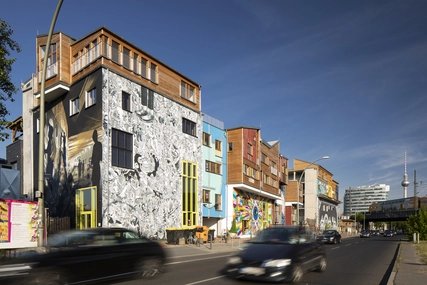
The Floating University, situated on the site of the former water retention basin at Tempelhof Airport (Lilienthalstraße 32), regularly hosts open discussion events, whilst CityLAB Berlin ( Platz der Luftbrücke 4, Tempelhof) offers space and support for anyone wishing to help shape a digital city of the future with their ideas. The results are presented and exhibited publicly.
One example is the Talking Treebot, which, with the help of ChatGPT and an environmental sensor, can make any tree ‘speak’. To do this, a microcomputer, sensor, USB speaker and microphone are attached to the tree via Velcro in a ‘trunk pouch’. The data recorded by the sensor, such as temperature and humidity at the tree’s location, is interpreted by the AI and influences the tree’s mood and the course of the conversation with passers-by.
You can currently try out the Treebot and other projects at the Kiezlabor. The open data platform “Gieß den Kiez” is already up and running, visualising over 800,000 urban trees and their watering requirements. Want to help? Then log in, grab a watering can and head to the nearest urban tree!

There is also space for collaborative discussion on urban practice on the site of the former GDR amusement park Spreepark | Plänterwald . Under the leadership of Grün Berlin and the Berlin Club Commission, discussions are taking place on how urban and social spaces can develop sustainably and in tandem, and how the environment and culture in Berlin are intertwined. Find out more about clubs as cultural spaces and about many places to visit in the city:
Tip 5: Living & Research – Urban neighbourhoods of the future

Of course, it’s not all about planning in Berlin. Much is already being put into practice. One example is the Urban Tech Republic. The research and industrial park, which is being built on the site of the former Tegel Airport, tackles the challenges facing growing cities through the resource-efficient use of energy and materials, climate-friendly mobility, and networked, data-driven infrastructure management. In the planned, neighbouring residential districts, climate-neutral construction and coexistence are being trialled right away. You can get an insight into the planning at the information point in the former canteen of the administration building.
Siemensstadt 2.0 – Campus of the Future
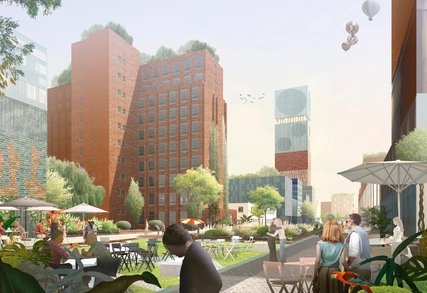
Another exciting new urban quarter is Siemensstadt². Where Siemens first established industry back in 1897, an open campus of the future is now taking shape. By 2030, a digital urban quarter is set to emerge here in Spandau, where people will live, research and work. Various tour operators offer guided tours of the site. By the way: the neighbouring Siemensstadt ring settlement is one of six Berlin modernist housing estates listed as a UNESCO World Heritage Site.
Tempelhof Airport – Urban coexistence of the future

At Tempelhof Airport, too, the future meets the past. Today, events and exhibitions take place in the building complexes and hangars of the former airport, and the site is now a hub for study and research. At the same time, new concepts of urban coexistence are being trialled. In the THF Tower itself, you’ll find an exhibition with a history gallery, and from the roof you have a 360° view of the neighbourhood. Combine your visit with a trip to Tempelhofer Feld: here, kitesurfers meet grazing sheep, skylarks and amateur gardeners.
Tip: Find out more about the history and future of the former Tempelhof Airport in our visitBerlin podcast, Berlin Unboxed.
Description
Das Video gehört zur Folge „Flughafen Tempelhof: Monument der Extreme“ von dem Podcast Berlin Unboxed, den visitBerlin betreibt. In dieser Folge von Berlin Unboxed nehmen wir euch mit an einen der geschichtsträchtigsten Orte der Welt; den ehemaligen Flughafen Tempelhof (THF). Burkhard Kieker, Geschäftsführer von visitBerlin, teilt persönliche Erinnerungen, mit Fabian Schmitz-Grethlein, Geschäftsführer der Tempelhof Projekt GmbH, sprechen wir über die aktuelle Nutzung des Flughafens Tempelhof und wie man einen Ort mit so viel Geschichte weiterentwickelt. Auf dem Standbild ist ein Ausschnitt des Vorfelds am Flughafen zu sehen, sowie der Propeller eines historischen Flughzeugs. Das visitBerlin Logo ist im linken unterem Eck. Die Untertitel des Videos können im YouTube Player unter Einstellungen an- und ausgeschaltet werden. Für eine Transkription sollte das Video direkt auf YouTube angeschaut werden.
EUREF Campus – Start-ups with innovative ideas

To ensure this idyll is preserved for the future, numerous companies and start-ups on the EUREF Campus are working on innovative ideas for the urban infrastructure of tomorrow. An immersive lift in the Schöneberg Gasometer offers a glimpse into the site’s future as it ascends. Once at the top, you can enjoy a 360-degree panoramic view of Berlin from the Gasometer Sky at a height of 66 metres. High above the city, the Sky Lounge – one of three bookable event spaces – also awaits you . Drop-in visitors will find a selection of restaurants and cafés.
FUBIC – The future innovation centre in Dahlem
Over the next few years, FUBIC – a new innovation centre for Berlin’s researchers and entrepreneurs – will be built on the site of the former US military hospital at Fabeckstraße 60–62 in Dahlem . One of the driving forces behind the project is Freie Universität Berlin, which also provides the first two letters of the name for the new tech and start-up park. Directly opposite, you can see the so-called ‘Mäusebunker’(Mouse Bunker), which was formerly used as the FU’s animal testing laboratory. Now a listed building, the structure with its dystopian-looking architecture is set to be repurposed.
WISTA Adlershof
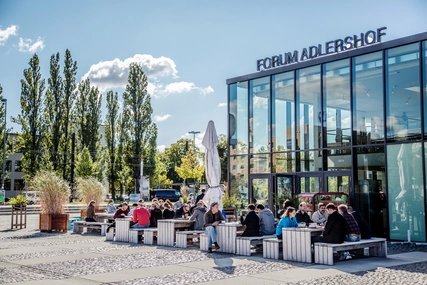
On a guided tour of the science city of Adlershof in Berlin’s Treptow-Köpenick district, you’ll gain a good insight into the capital’s innovative spirit. In addition to the technology park – incidentally the largest in the whole of Germany – you can also visit the Adlershof Campus or the television studios. Take a journey through 100 years of aviation history or learn more about prototypes for the energy transition.
Tip 6: Top ‘Instagrammable’ places of the future: architecture and urban planning
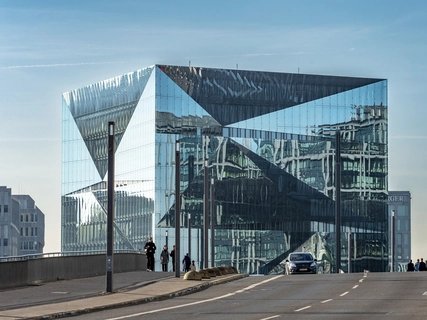
8,000 square metres of reflective glass give the Cube on Washington Platz its futuristic appearance. The 11-storey “smart” office building, equipped with 3,800 sensors, is ready for the working world of the future, where the Internet of Things is fully integrated into everyday working life. From the right angle, spectacular images can be captured in front of the Cube’s façade, reflecting the sun, sky and surroundings.
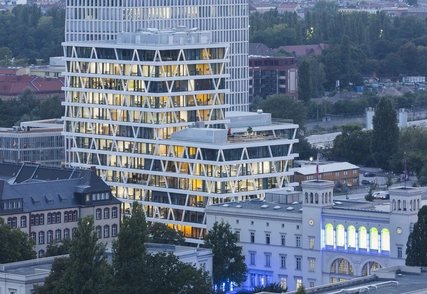
Right behind the Cube, Europacity is emerging as a veritable district of the future. Some of the futuristic-looking building complexes have already been completed. Examples include the EDGE, which is regarded as Europe’s most intelligent and innovative office building. Other complexes feature new energy concepts; for instance, the 50Hertz generates its own energy using a wind farm on its roof.
Built in 1909 as a shopping arcade, the Tacheles established itself after reunification as a creative hub of Berlin’s cultural scene. Following its forced eviction in 2012, the complex fell into disrepair. Now, new life has moved into Berlin’s famous ruin. In the stylish arcades, you’ll find a mix of flats, offices and shops, along with a touch of art, including a Berlin branch ofthe Swedish photography museum Fotografiska.
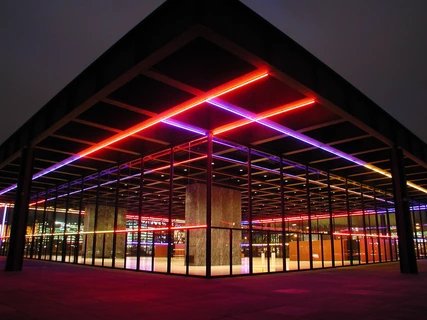
The future is also being built and shaped in Berlin’s ‘Neue Mitte’. You can already visit some highlights, such as the Neue Nationalgalerie or the Humboldt Forum . We have put together a comprehensive overview for you here.
Tip 7: Tech fairs and events on future and digital themes

Several conferences in Berlin also address future-oriented questions and themes every year. For instance, the annual Berlin Questions event tackles questions of urban coexistence in the future and focuses on local solutions to global challenges.
, for example, is home tore:publica, Europe’s largest conference on the internet and digital society. Over three days, representatives from academia, the media, politics and business, alongside hackers, NGOs, bloggers, activists and creatives, discuss the future and current issues.
At IFA, you can be there live when new technologies and products are unveiled for the first time. The global tech show for consumer and home electronics focuses on the tech trends of the future over five days. Be inspired and network on site.
Tip: During the Long Night of Science, you’ll gain insights behind the usually closed doors of Berlin’s universities and research centres.
Everything you need to know about events in Berlin can be found in our Meeting Guide:
Tip 8: Innovative shopping concepts

Tech enthusiasts who like to try out new things but don’t want to buy them straight away are in good hands at Grover . The Berlin-based start-up offers gadgets such as smartphones and VR headsets for hire rather than for sale.
With NochMall , Berlin’s city cleaning service has established its own department store for second-hand goods. Of course, you can also enjoy great shopping at Berlin’s numerous flea markets.
Tip 9: Snacks with a twist: is this how we’ll eat in the future?

Microsoft invites you to the digital eatery (Unter den Linden 17, Mitte) to discuss and experiment. Here you can have lunch and take part in free workshops or even an Xbox party. O2’s BASECAMP (Mittelstraße 51, Mitte) also sees itself as a forum for debate on digital culture and serves coffee and light meals on the side. If you’re interested in Berlin’s young entrepreneurial scene, you should also pop in for a coffee at Berlin’s oldest co-working space, St. Oberholz at Rosenthaler Straße 72A in Mitte.
Berlin cuisine: healthy & innovative
Berlin’s restaurant scene is not only multicultural but also innovative. AERA bakes gluten-free sourdough bread, whilst WoopWoop Icecream produces fresh ice cream in a matter of seconds by mixing fresh ingredients with liquid nitrogen at -196°C. At Mikrokosmos ( Reichenbergstraße 122), menus featuring mealworms and grasshoppers are served, and Café Botanico grows the fresh ingredients for its dishes in its own permaculture garden.
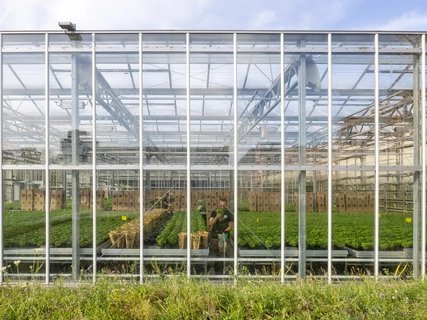
The ECF Farm on the grounds of the Malzfabrik combines urban farming with aquaponics and uses fresh ‘Capital Perch’ to fertilise the aromatic ‘Capital Basil’, which thrives magnificently above the aquariums. Both fish and basil are available for purchase on site, or at the local supermarket. And the start-up SPRK.global Anthropia has developed an algorithm that enables surplus food to be located, redistributed and utilised accordingly.
Listening tip: Find out more about innovative concepts in Berlin’s restaurants in our visitBerlin podcast Berlin Unboxed
Tip 10: Fast and convenient on the go: sustainable mobility concepts

Anyone travelling around Berlin can easily do without a car. The city, start-ups and the Berliner Verkehrsbetriebe (BVG) have jointly established a highly effective mobility network that works equally well for Berliners and visitors alike. It’s best to download the Jelbi app onto your smartphone before your trip to Berlin. Here you’ll find all public transport connections combined with last-mile options such as electric scooters, bike hire, e-mopeds, car-sharing, electric cars, taxis and, of course, the BVG shuttle service BerlKönig – though this is set to be replaced by new on-demand services by the end of 2025. To this end, the Berlin Transport Authority is collaborating with the company Via Transportation. Among other things, the New York-based company develops ride-pooling algorithms for on-demand services provided by public transport operators in 35 countries.
Tip: With the Berlin WelcomeCard , you not only travel for free on all public transport, but also receive discounts at numerous attractions in Berlin.
Berlin WelcomeCard
Autonomous driving

Together with partners from the city, the research sector and industry, Berlin’s BVG has been testing the use of autonomous electric minibuses for several years. Highly automated fleet vehicles have been tested under the project name SHUTTLES&CO. The long-term aim is to supplement the existing route network and make local public transport more attractive.
The test phase of the autonomous revolution in north-west Berlin will end in 2027. Here, the first VW ID. Buzz AD vehicles are operating on public roads. The aim of the pilot project is to deploy a larger fleet of autonomous vehicles across the wider urban area.
The Technical University of Berlin is also conducting research into autonomous driving.


