

Neue Nationalgalerie
The world-famous Museum of Classical Modernism
The Neue Nationalgalerie is one of Berlin's most renowned cultural venues. Immerse yourself in the fascinating worlds of great artists of the 20th century.
After six years of restoration work, the Neue Nationalgalerie once again opened its doors in 2021. The magnificent collection of 20th century visual art has moved back in. There are also exciting new exhibitions to see as well.
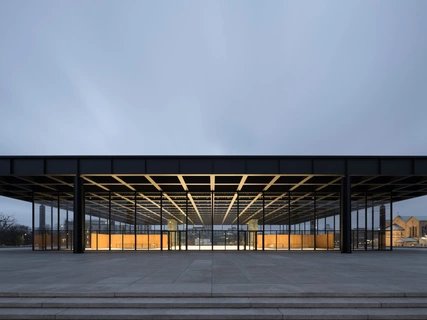
Mies van der Rohe's steel and glass architecture with its vast hall flooded with light has been fascinating visitors with its unique construction since it was built 50 years ago: only eight slender pillars outside the glass façade support the monumental, 65-square-metre coffered roof.
The restoration of the Neue Nationalgalerie barely leaves a trace: "As much Mies as possible"
"Our work was surgical in nature. We hope to have returned this beloved patient seemingly untouched except for it running more smoothly."
Words from British star architect David Chipperfield on the €140 million restoration of Mies van der Rohe's world-famous museum building that he was commissioned with seven years ago. Chipperfield had already undertaken several internationally acclaimed projects in Berlin before, such as the reconstruction of the Neues Museum on Museum Island. The difference to the restoration of the Neue Nationalgalerie is noticeable: although the building was stripped down to its foundations, it has remained as Mies van der Rohe first designed it - even a reproduction of the original carpet has been laid in the exhibition rooms.
Spectacular exhibitions
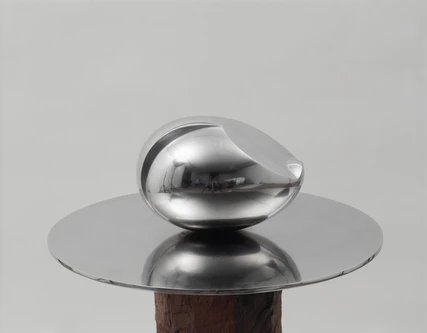
Exciting temporary exhibitions are presented in the large, light-filled space of the upper glass hall. Until 9 August 2026, you can see a comprehensive retrospective here on Constantin Brancusi, a pioneer of modern sculpture. In collaboration with the Centre Pompidou , the exhibition offers the most extensive overview of his work in Germany in over 50 years. Over 150 works are on display, including sculptures, photographs, films and archive materials. Brancusi’s organic forms, reduced to their essence, made the artist a pioneer of abstraction. Highlights include iconic works such as ‘The Kiss’, ‘Bird in Space’ and ‘Endless Column’, as well as a partial reconstruction of his legendary studio.
The collection galleries in the basement are showing the exhibition“Zerreißprobe. Kunst zwischen Politik und Gesellschaft”(The Test of Strength:Art between Politics and Society) until 25 April 2027. This exhibition focuses on art from 1945 to the turn of the millennium, an era marked by upheavals, conflicts and artistic renewal. Set against the backdrop of the Cold War, the fall of the Berlin Wall and social emancipation movements, the works reflect on central questions of identity, politics, everyday life and aesthetics. On display are diverse works from East and West, ranging from Art Informel through Pop and Conceptual art to performance and video, featuring artists such as Joseph Beuys, Andy Warhol and Marina Abramović. The exhibition is complemented by previously unseen works as well as current presentations, including a dedicated room for Christoph Schlingensief’s“Deutschlandsuche ’99”and kinetic works by Rebecca Horn.
At the heart of Gerhard Richter. 100 Works for Berlin, a long-term loan from the Gerhard Richter Art Foundation, is the four-part cycle “Birkenau” (2014), in which Richter engages intensively with the Holocaust and its representability. The starting point is historical photographs from Auschwitz-Birkenau, which he first rendered in paint and then abstracted layer by layer until the original motif disappeared. A mirror placed opposite adds an additional layer of reflection to the work. The presentation is complemented by around 90 further works from various creative phases, including well-known pieces such as “Besetztes Haus”, “4900 Farben” and “Strip”, as well as overpainted photographs that explore the tension between photography and painting. In future, the presentation is to be continually recontextualised through changing artistic interventions.
On the western side of the lower level, a door leads into the green outdoor sculpture garden. Inspired by MoMA’s sculpture garden in New York, it was designed as an extension of the museum space. Between plants and sculptures, the garden’s water feature is now back in its original location, where a special highlight of the collection, Sky Piece by David Black, can be seen.
The Neue Nationalgalerie: An Icon of Architectural History
The Neue Nationalgalerie, opened in 1968 not far from Potsdamer Platz on the Reichpietschufer, was Mies van der Rohe's last solo work. The building with its flowing, open hall and seemingly floating flat roof is considered to be an icon of architecture. The glass enclosure and the design language reduced to the essentials set the mood for the collection. The concept: temporary exhibitions take place in the main hall, the glass pavilion, while the lower level houses the permanent exhibition.
In the freshly renovated building, a special exhibition is dedicated to the architectural history of the Neue Nationalgalerie and its architect Ludwig Mies van der Rohe. The focus is on the construction period (1965-1968) and on the major restoration work performed by David Chipperfield and his team over the last six years (2015-2021). Artworks from the Neue Nationalgalerie’s collection which have a connection with the museum’s architecture provide a visual illustration to complement this historical exhibition.
The Neue Nationalgalerie collection
The Neue Nationalgalerie’s collection contains magnificent milestones of painting and sculpture - from classical modernism to the 1980s. German Expressionism forms a focal point, with Ernst Ludwig Kirchner, Otto Dix and Max Beckmann as its protagonists. Dalí, Miró and Picasso take us on a journey into Surrealism, while Klee and Kandinsky provide insights into the teachings of the Bauhaus - the world-famous art and design school. On large canvases, colourful and abstract works by the American painters Barnett Newman, Frank Stella and Ellsworth Kelly herald a new era.
Highlights
- The Neue Nationalgalerie building by Mies van der Rohe - an icon of modern architecture
- The Pillars of Society (1926), George Grosz
- Potsdamer Platz (1914), Ernst Ludwig Kirchner
- Eiffel Tower (1928), Robert Delaunay
- Head in Brass (1925), Rudolf Belling
Art, culture and politics around Berlin’s Kulturforum
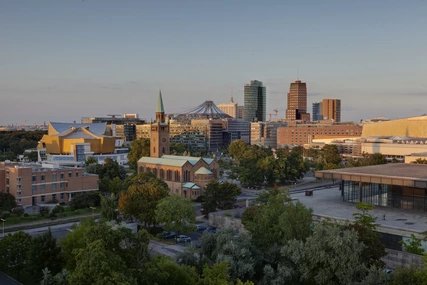
Great art is also right at home in the Gemäldegalerie (Portrait Gallery) at the Kulturforum. Marvel at the famous paintings from the 13th to 18th centuries, including works by Titian, Holbein, Dürer and Rembrandt. The Botticelli collection is one of the most renowned in the world. A few steps away, the Kunstgewerbemuseum (Museum of Decorative Arts) at the Kulturforum presents precious medieval goldsmith's work, ornately painted maiolica and filigree porcelain. A look at the history of design from the Middle Ages to the present day is also exciting. The Kulturforum opposite Potsdamer Platz is one of Berlin's major cultural centres. Its prestigious museums, the Berlin Philharmonic, the Chamber Music Hall and the Staatsbibliothek are of international standing. In the project "Utopia Cultural Forum", the potential of the Cultural Forum is made visible with exhibitions, city talks and art actions.
Crossing the Großer Tiergarten park from the Kulturforum, you can then reach Bellevue Palace, the official residence of the Federal President, on the banks of the Spree. Prince Ferdinand of Prussia had the stately three-wing complex built as a pleasure palace in the 18th century.
Information for your visit to the Neue Nationalgalerie
You can easily reach the Neue Nationalgalerie by taking the U2 underground line to the Potsdamer Platz station. The S-Bahn lines S1, S2 and S25 also stop here. The visitor entrance to the Neue Nationalgalerie is located at Potsdamer Straße 50. With the 3-Day Berlin Museum Pass you can visit the exhibition free of charge.
Please note: On Thursdays from 4 p.m. to 8 p.m., visits to the Neue Nationalgalerie, including special exhibitions and the Sculpture Garden, are free of charge for all guests.
Opening hours
| Tuesday | |
|---|---|
| Wednesday | |
| Thursday | |
| Friday | |
| Saturday | |
| Sunday |
Opening hours (additional information)
Admission to the Neue Nationalgalerie is free every first Thursday of the month from 4 pm to 8 pm.


