

Kulturforum
The Neue Nationalgalerie, the Berlin Philharmonie and the State Library
Right in the heart of Berlin, near Potsdamer Platz, you can experience a wide and varied range of cultural attractions in one place: the Kulturforum. The Kulturforum comprises the Neue Nationalgalerie and other major museums such as the Gemäldegalerie, as well as the State Library and one of the world’s most famous concert halls: the Berlin Philharmonie.
The Kulturforum
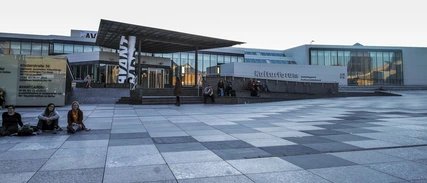
In the heart of Berlin, close to Potsdamer Platz, numerous museums and cultural institutions are clustered around a large open space. The steeple of St Matthew’s Church rises from the ensemble of buildings like a lighthouse. The focus is currently on the major construction site for the future ‘berlin modern’, the National Gallery’s new museum dedicated to 20th-century art.
The Kulturforum comprises:
- New National Gallery
- Gemäldegalerie
- Cabinet of Prints
- Museum of Decorative Arts
- Art Library
- Philharmonie
- Chamber Music Hall
- Museum of Musical Instruments
- State Library
- Ibero-American Institute
- St Matthew’s Church
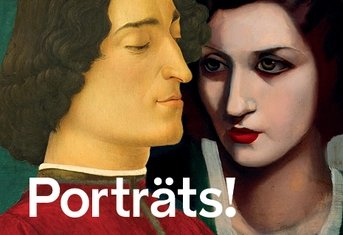
From Oct 16, 2026 to Mar 14, 2027, the Gemäldegalerie invites you on a journey through six centuries of portraiture, bringing masterpieces by Botticelli, Dürer, Rubens and others together in surprising pairs.
Current situation
Another major museum is currently being built at the Kulturforum: ‘berlin modern’, the Museum of the 20th Century.
The development of the open space between the Philharmonie and the New National Gallery is intended to create a stronger spatial connection between all the buildings.
The winning design in the competition was submitted by the Swiss architectural firm Herzog & De Meuron. The opening is scheduled for 2030. Further masterpieces of the 20th century from the National Gallery’s collection will be on display here.
As part of the ‘Utopie Kulturforum’project, local residents living near the Kulturforum are working together to explore the Kulturforum’s potential through decentralised exhibitions, public discussions and art events, and to raise its profile amongst the general public.
History of the Kulturforum
The Kulturforum looks back on a varied history of its origins and construction.
The 1950s
By the end of the 1950s, plans were in place for a cultural axis running right through Berlin. These were based on ideas by the architect Hans Scharoun, then President of the Academy of Arts. The Wall had not yet been built, and the axis was to stretch from Museum Island in the east to Charlottenburg Palace in the west.
The site of today’s Kulturforum lies right in the middle. As a result of massive planning interventions during the Nazi era and the destruction of the Second World War, the area lay fallow. A new cultural centre for the burgeoning post-war Berlin was to be built there.
In future, visitors will be able to enjoy art, listen to music and study academic works here. The aim is for the impact of the individual institutions to be enhanced by their concentration in one place – that is the plan.
Then came the construction of the Berlin Wall, and the Kulturforum, situated close to the Wall, became a major prestige project for the West. The aim was to hold its own in the ongoing rivalry with the GDR regime, whilst also sending a clear message to West Germany. The repatriation of the art and literary collections that had been relocated to the Federal Republic was progressing anything but swiftly. The construction of suitable buildings was intended to increase the pressure to bring them back to West Berlin.
The 1960s and 1970s
The process began in the 1960s and 1970s with three designs by two internationally renowned architects. Hans Scharoun’s Philharmonie marked the start of construction work at the Kulturforum. It was inaugurated in 1963.

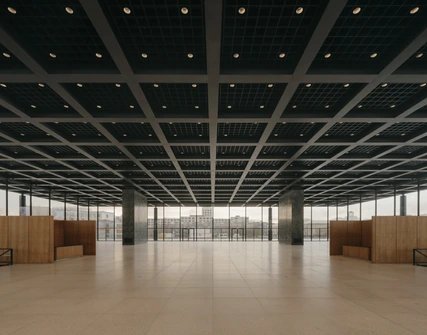
Its unusual tent-like roof shape and yellow façade contrast with those of Ludwig Mies van der Rohe’s Neue Nationalgalerie, which opened five years later – a steel-and-glass structure featuring a spacious, light-filled exhibition hall.
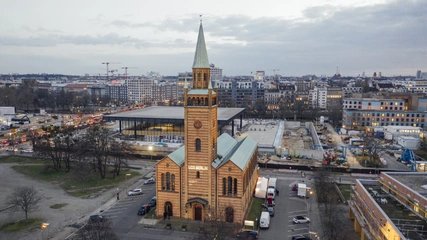
St Matthew’s Church, which has stood on this site since the 19th century, seems as though it has been frozen in time. St Matthew’s Church in Berlin’s Kulturforum is a historic focal point, a space for contemporary art and a place of religious tranquillity. Culturally speaking, St Matthew’s Church is one of the key players in the Kulturforum.
Scharoun’s long-standing colleague Edgar Wisniewski realised the Chamber Music Hall and the Museum of Musical Instruments according to Scharoun’s plans. The museum opened in 1984, and the Chamber Music Hall in 1987, to mark the 750th anniversary of the city of Berlin.
In the 1970s, the State Library was built on the other side of Potsdamer Straße according to Scharoun’s designs. It opened in 1978, six years after the architect’s death. The neighbouring Ibero-American Institute was also based on a design by Scharoun.
The construction of the State Library cost more than originally estimated. This led to a delay in the start of construction on the other planned art centres.
The 1980s and 1990s
West Berlin had already launched an architectural competition in 1965 for the design of the entire Kulturforum. Expectations were high; the most convincing design was expected to offer nothing less than an ‘architectural definition of what a museum means to us today’.
In the jury’s view, no entrant in the competition achieved this ambitious goal. As a compromise, those in charge agreed to award the commission to the Stuttgart-based architect Rolf Gutbrod.
His designs date from a time when questions about the role and function of museum architecture were beginning to emerge. What is the interrelationship between museums and the collections they house? Which target audiences should be addressed?
The architect viewed his designs as a contrast to the classical and neo-Baroque buildings on Museum Island. His museums were not intended to intimidate, but rather to encourage people from all social classes to visit.
In 1985 , the Museum of Decorative Arts opened . The concept behind the building, designed 20 years earlier with its Brutalist façade and dominant stairwells , was by this point outdated. And it did not go down well with the public: the criticism was devastating, forcing Gutbrod to step down. For the time being, the future of the Kulturforum remained uncertain.
The Munich architects Heinz Hilmer and Christoph Sattler were commissioned to revise Gutbrod’s designs for the Kupferstichkabinett and the Kunstbibliothek . They altered numerous details; for example, the exposed concrete columns planned for the exhibition hall were omitted.
The building opened in 1994. Today, the building’s façade, clad in concrete and clinker brick, has a distinctly understated appearance.
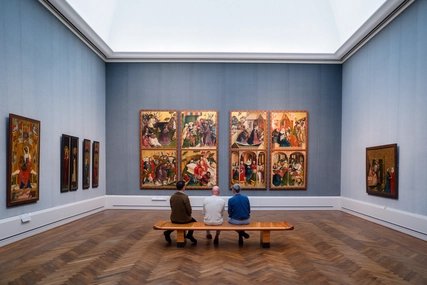
The Picture Gallery was also designed by Hilmer and Sattler and opened in 1998. They had to adapt their design, as the location and entrance had been specified by Gutbrod. The architects eschewed grand façades and focused on the quality of the interior design. Classically proportioned galleries with perfect lighting conditions show the precious collection to its best advantage.
The refurbishment of the Neue Nationalgalerie, 2015–21
Mies van der Rohe’s steel-and-glass architecture – a vast, light-flooded hall – was already a source of fascination 50 years ago thanks to its unique construction: Just eight slender, soaring support pillars outside the glass façade bear the monumental coffered roof, measuring 65 by 65 metres.
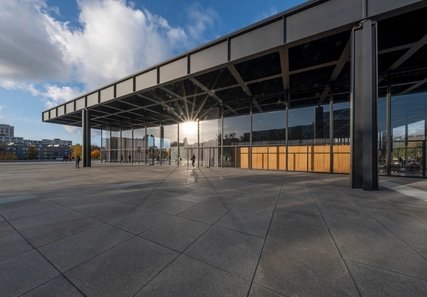
The renovation of the Neue Nationalgalerie has left hardly any traces:
“Our work was of a surgical nature. We hope to have discharged the patient seemingly unscathed – only in a much better condition.”
Words from David Chipperfield on the restoration of Mies van der Rohe’s world-famous museum building. Chipperfield had already undertaken several internationally acclaimed projects in Berlin, such as the reconstruction of the Neues Museum on Museum Island. The difference compared with the renovation of the Neue Nationalgalerie is striking: although the building was stripped back to its foundations, it has remained exactly as Mies van der Rohe conceived it – even an original, re-woven carpet has been relaid in the exhibition rooms.
The “Utopia Kulturforum” project
Description
Das Video gehört zur Folge „Utopie Kulturforum“ von dem Podcast Berlin Unboxed, den visitBerlin betreibt. Der Podcast erzählt die Geschichte des Kulturforums. In dem Video ist ein Standbild vom Innenraum der Neuen Nationalgalerie mit Blick durch das Fenster auf das Kulturforum zu sehen sowie das visitBerlin Logo im linken unterem Eck. Die Untertitel des Videos können im YouTube Player unter Einstellungen an- und ausgeschaltet werden. Für eine Transkription sollte das Video direkt auf YouTube angeschaut werden.
Our podcast ‘Berlin Unboxed’ takes you to places that aren’t usually easily accessible.
In this episode, we climb the steeple of St Matthew’s Church with Reverend Hannes Langbein and discuss the visions for the ‘Utopia Kulturforum’.
Listen to the Berlin Unboxed podcast
Nearby attractions
German Resistance Memorial Centre
Practical information
The Kulturforum at Potsdamer Platz is connected to the S-Bahn and U-Bahn networks. Bus routes (M29, M48, 200) will take you from there to City West, the historic city centre and Alexanderplatz. To explore the city, we recommend the Berlin Welcome Card for public transport. It can be combined with the Museum Pass issued by the Staatliche Museen zu Berlin. Children and young people up to the age of 18 enjoy free entry to many museums.


