

Humboldt Forum
Art Collections & Exhibitions, Events & Workshops
Museums from the Museum Pass
Top sights
Viewpoints
Architecture
Top museums
Museums open on monday
History museums
Accessible museums & culture in Berlin
Right in the heart of Berlin, directly opposite Museum Island, lies the Humboldt Forum: a unique, cosmopolitan space for experiences situated on the authentic historic site of the Berlin City Palace. With outstanding art collections, exhibitions and workshops on culture and science, it is a special place for diversity, exchange, discussion and inspiration.
Distinctive architecture
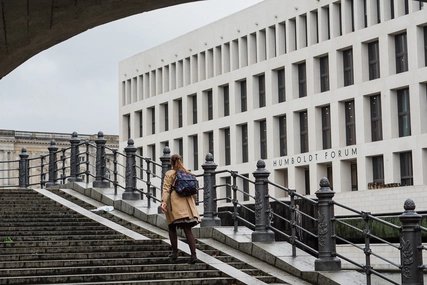
The Humboldt Forum in Berlin Mitte – visible from afar – covers an area of around 30,000 square metres. The reconstructed Baroque palace façades on the north, south and west sides of the Forum gleam in a pale quince-yellow hue. The east side of the Forum on the banks of the Spree offers a surprise: a modern, smooth exterior façade, in front of which stands the ‘Spreebalkon’, and down by the riverbank, just above the water’s surface, a large terrace.
Thus, the architecture of the Humboldt Forum thrives on a striking contrast between ultra-modern architectural elements and the reconstructed sculptural façades of Berlin’s former Baroque City Palace. The creator of this unique design and architect of the Humboldt Forum is the Italian architect Franco Stella. He won the competition for the reconstruction in 2008.
Inspiration, Action and Exchange
What can visitors expect when they pass through one of the imposing portals?
Firstly, two large city squares open to public life: the spacious Schlüterhof, home to the Lebenswelten bistro and the visitBerlin Tourist Information centre, and the Passage, a wide colonnaded walkway running right through the building.
From the Humboldt Forum’s roof terrace, you’ll enjoy a fantastic view of Museum Island, Alexanderplatz and many other landmarks. Be sure to visit the upmarket restaurant Baret whilst you’re there, where you can combine the sweeping views over Berlin with the pleasure of culinary delights.
The interior of the Humboldt Forum makes a striking impression at first glance: a spacious foyer on the ground floor connects high-ceilinged, modern gallery walls with the reconstructed palace portal. Here stands the‘Kosmograf’, a 17-metre-high media tower and master of transformation: not only does it display information, but it can also transform at any time into a gigantic art and light installation.

Through the foyer, visitors gain access to the museums and special exhibition spaces.
Immerse yourself in the history of the site
In the sculpture hall on the ground floor, visitors can view the original sandstone figures from the palace façades up close. And on the south side of the Humboldt Forum, a 28-metre-long video panorama vividly illustrates the site’s historical development – dating back to the earliest records in the 12th century. Visitors can then really immerse themselves in the history of the site in the palace cellar: here, the remains of the medieval Dominican monastery and the foundations of the palace have been uncovered.
Berlin Global
On the first floor of the accessible building, the exhibition ‘Berlin Global ’ offers a surprising glimpse of Berlin from new perspectives: the focus here is not only on global developments that have influenced and transformed Berlin. It also explores – together with visitors – how Berlin has shaped the world and what impulses have emanated from this city. Imaginative media installations and the‘World Studio’, where visitors are asked about their personal experiences, showcase the city as part of a richly interconnected world.
The Humboldt Laboratory
Science and cutting-edge research into global challenges – not from a distance, but up close and tangible: the Humboldt Laboratory, a project of Humboldt University of Berlin, is a think tank for anyone wishing to take part in the process of scientific research and discuss global problems and challenges: climate change, environmental degradation, species extinction, and major social injustices. Right at the entrance to the Humboldt Laboratory, visitors are immersed in the world of research via a large model of a school of fish, a symbol of swarm intelligence.
Museum of Ethnology and Museum of Asian Art
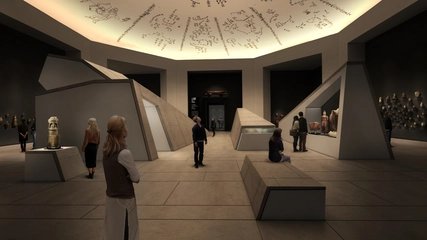
Spectacular Chinese court art, richly decorated houses from Oceania or a throne from the Kingdom of Bamum in Cameroon: On the second and third floors of the Humboldt Forum, some 20,000 aesthetically outstanding exhibits spanning from the 5th millennium BC to the present day are displayed across 16,000 square metres: in the Museum of Ethnology and the Museum of Asian Art.
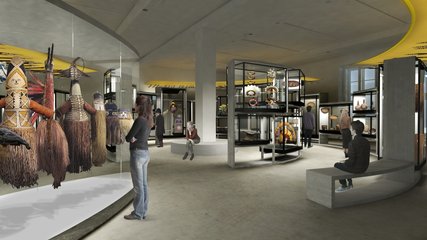
But these unique artefacts do more than simply showcase the fascinating traditions of other cultures. A special exhibition also explores the circumstances under which they were taken from indigenous communities, the dilemma faced by local stakeholders – in short: the difficult history of colonialism and Europe’s role, with its repercussions continuing to the present day.
In the large exhibition area of the museums in the east wing, visitors can view displays from the collections relating to North, Central and South America, as well as a further section of the collection of objects from Asia and Africa, featuring highlights such as the exhibition area on the global diversity of Islam and the historic Kingdom of Benin.
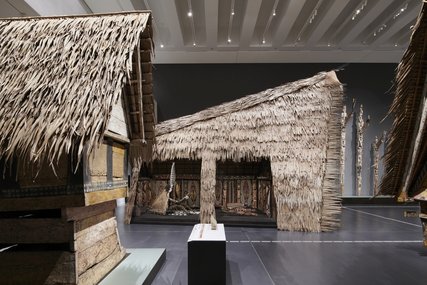
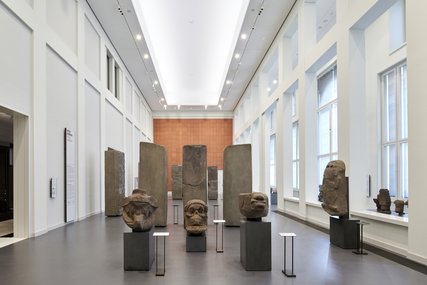
Not your typical museums
New and extraordinary: the exhibitions also feature works by contemporary artists that either refer directly to the objects on display or engage with them. Another special feature is the sound installations in a unique elliptical listening room, created on the basis of research in ethnomusicology.
Highlights
- Outrigger canoe from the island of Luf (1890–1895), Papua New Guinea
- Kangaroo tooth necklace (before 1875), Australia
- Township Wall (2001/2018), António Ole
- Nandi processional bull (17th century), South India
- Kizil Cave (6th–7th centuries), Xinjiang, China
- Lienzo Seler II / Coixtlahuaca II (16th century), 16 square metre cotton cloth, Mexico
Nearby attractions
- Berlin Cathedral with the Hohenzollern Crypt
- Museum Island with the Altes Museum, Neues Museum, Alte Nationalgalerie, Pergamon Museum and Bode Museum
- German Historical Museum
- GDR Museum
- Neue Wache
History of the site
The history of the site on which the Humboldt Forum stands is marked by significant breaks and upheavals – and symbolises Berlin’s eventful history. For many centuries, the magnificent Baroque City Palace of the Hohenzollerns stood on this very spot, undergoing repeated extensions and alterations. Having lost its significance following the end of the monarchy in 1918, it suffered extensive damage during the Second World War and was demolished in 1950 on the orders of the GDR leadership. In the 1970s, the GDR government then built its socialist Palace of the Republic on this site, which met a similar fate after reunification: Stripped of its political significance, it fell into disrepair and disappeared from the centre of Berlin in 2008 to make way for the construction of the Humboldt Forum.
But the history of the site where the Humboldt Forum now stands is much older.
Over 800 years ago…
In the 13th century, the first houses of the medieval twin city of Berlin-Cölln stood on the site of the Humboldt Forum. From 1300 onwards, numerous houses were demolished to make way for the construction of a large Dominican monastery. Its archaeological remains are on display in the castle cellar of the Humboldt Forum, alongside the foundations of the Baroque palace.
In 1415, the first Hohenzollerns arrived in the city. Over the following decades, they made their claim to power unmistakably clear to the citizens of Berlin: Elector Frederick II began building the first palace right in the heart of Berlin – against the resistance of the population, who did not wish to see their civic city replaced by a princely capital. All this discontent erupted in an incident at the palace building site in 1448:
The Berlin Uprising of 1448
A day in medieval Berlin that has gone down in history as the ‘Berlin Uprising ’: an angry crowd gathers at the palace building site, loud shouts ring out. Then, armed with axes and pickaxes, they set about demolishing the embankment that protects the building site from flooding by the River Spree. The enraged citizens destroy the weir, and the waters of the Spree flood the castle square. A success – but only a short-lived one. For a barrage of fines followed, and the palace was built anyway.
Around 500 years of Hohenzollern rule
For half a millennium, Berlin remained firmly tied to the Hohenzollern dynasty. And just as the Hohenzollerns’ rule continued to expand – they had been kings of Prussia since 1701 and German emperors since 1871 – so too was the City Palace in Berlin repeatedly extended and modernised.
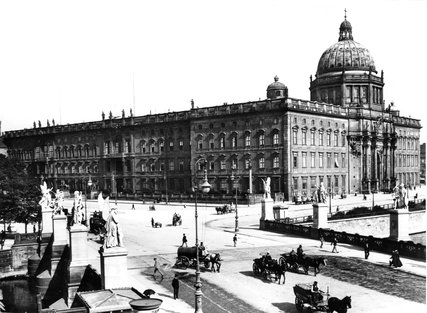
The Humboldt Forum: historical upheavals after 1918
In 1918, the German Empire came to an end – after many centuries of monarchy. And the site of today’s Humboldt Forum was once again at the heart of the action. The consequences extended far beyond the country’s borders: on 9 November, Karl Liebknecht, accompanied by a large crowd of demonstrators, proclaimed the socialist republic in front of the Hohenzollern Palace. By this time, the imperial family had long since fled Berlin and had retreated to Potsdam for the time being.
Over the following years, the palace became home to a wide variety of political, social and cultural institutions – it even housed a student hall of residence and a soup kitchen.
After the Second World War, the palace – destroyed by bombing – lay within the Russian occupation zone and later on the territory of the newly founded GDR. The new GDR leadership identified the vast site in the heart of Berlin as the ideal location for a symbolic act: The demolition of the palace ruins was intended to erase all memory of the site’s history; instead, the Palace of the Republic – a multifunctional building housing the seat of the GDR government – was erected here and stood for several decades.

This, too, was subsequently demolished following reunification….
The new Humboldt Forum stands as a place of cosmopolitanism, discussion and exchange in a location where the history of Berlin and Germany is reflected and condensed, and which, over the centuries.
Opening hours
| Monday | |
|---|---|
| Wednesday | |
| Thursday | |
| Friday | |
| Saturday | |
| Sunday |


