

Pfefferberg
From brewery to cultural complex
The Pfefferberg area in Prenzlauer Berg, once a brewery site on the outskirts of Berlin, is now one of the capital's most interesting cultural hotspots.
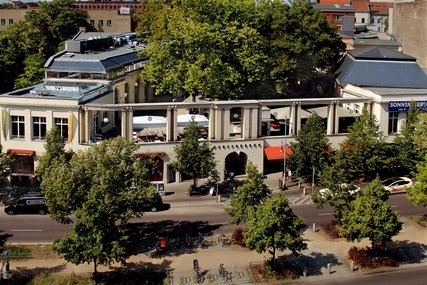
As you approach the former brewery site from Schönhauser Allee, you can't miss the name: "Pfefferberg" is emblazoned on the entrance gate, which is crowned by a row of massive pillars. A flight of stairs takes you to one of Berlin's most beautiful beer gardens. Take a seat at one of the tables in the shade of the trees and enjoy a cold beer from the on-site brewery.
The brewery pub, which opened on the site in 2013, completes the circle of Pfefferberg history after 170 years. But the area has a lot more to offer than just gastronomic highlights: since the 1990s, art, architecture and cultural events such as dance and theatre performances have been held here.
"Tasty Bavarian beer" in the great outdoors
Given its location in the centre of Prenzlauer Berg, it's hard to imagine today, but in the beginning the brewery had an idyllic location in the middle of fields.
Joseph Pfeffer, a native of Bavaria after whom the site is named, acquired an undeveloped plot of land in 1841 to build a brewery. His unique selling point: he was the first in the area to brew bottom-fermented beer. As this type of brewing requires low temperatures, the hilly terrain is ideal for setting up a lager cellar.
Three years after the purchase, Pfeffer opens the "Beer taproom of the new Bavarian Beer Brewery Schönhauser Allee 176". This means that not only beer brewing but also catering has a long tradition on Pfefferberg.
But even though the Vossische Zeitung praised the "prompt service" and "tasty Bavarian beer" after the opening, the place didn't really get off the ground. Pfeffer was forced to sell the premises again after just a few years.
Lots of beer, little space
From the middle of the 19th century until the 1920s, beer production continued on Pfefferberg. After several changes of ownership, the brewery business picks up speed. Beer consumption rises steadily over several decades, with malt consumption increasing tenfold between 1861 and 1887. While the company was still producing 45,000 hectolitres of beer per year in the 1880s, this figure had risen to around 150,000 by the beginning of the 20th century.
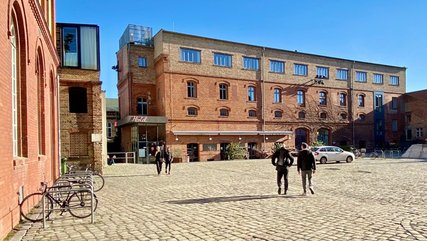
In order to meet demand, the brewery had to become an industrial operation. This required numerous conversion measures on the site. Many of the buildings you see today on the Pfefferberg date from the period between 1880 and 1900.
Bread, chocolate and printing ink
During the First World War, beer production on the Pfefferberg came to a standstill. Max Hoffmann, son of Sarotti founder Hugo Hoffmann, became the new owner in 1922. Instead of beer, "cocoa, chocolate and sugar products" are now produced here. A remodelling of the buildings turns the brewhouse, the bar hall and the bottle cellar into rooms for confectionery production, such as a fruit cookery as well as powdering, coating and packing rooms for chocolates.
But the products manufactured on the Pfefferberg were not to remain so sweet for long: In the early 1930s, the Moabit "Germania Spezialbrotbäckerei" bakery moved in and baked pumpernickel, vitamin bread and bread suitable for diabetics in the former Schwankhalle.
After the war, the production of food and beverages on the Pfefferberg ends for the time being: "Neues Deutschland" Druckerei und Verlags GmbH, the organ of the SED, now starts its printing operations here. 1973 marks the end of the Pfefferberg's use as a factory site. Until reunification, a wide variety of facilities can be found on the site, from workshops and offices to the Prenzlauer Berg building and civil engineering office.
Historical architectural highlights
The area's chequered history has also left its mark on the buildings. On Schönhauser Allee, you are greeted by a terraced structure with column elements in the upper part and implied round arches in the lower part. The architect Otto Rudolf Salvisberg built this separation between the street and the area between 1911 and 1912. In the 1920s, he was also involved in the modern housing estates Onkel Toms Hütte and Weiße Stadt.
In the beer garden, you can see the oldest building on the site from the period after 1842, in which one of the brewery operators lived privately in the 1850s. Its most striking feature is the late classicist, wide columned portico in front of the entrance.
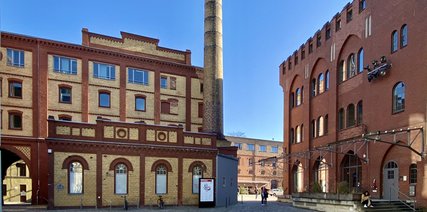
Passing the building on the left, you come to one of the courtyards around which the original brewery buildings are still grouped. They reflect the widespread historicist industrial architecture of the late 19th century, such as House 2: it is clad in red clinker brick, the round and pointed arch elements and the crenellated projections at the top are reminiscent of medieval buildings. Formerly a bottling plant, it now serves as an art studio.
You will find a special architectural highlight if you walk past house 2 on the right in the direction of Christinenstraße.
Museum for Architectural Drawing
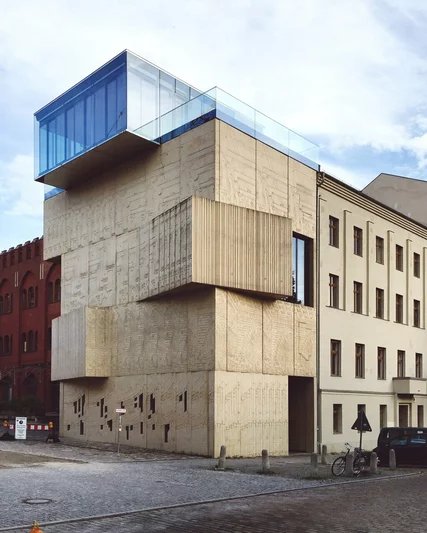
The architect Sergei Tchoban opened the Museum of Architectural Drawing here in 2013 to exhibit his collection of historical, hand-drawn architectural plans.
The building consists of five storeys, which resemble stacked boxes with their different depths and angles. The lower four storeys are clad in sandy yellow concrete, which contrasts sharply with the glazing on the top floor.
If you look closely, the building already gives you a foretaste of the exhibits on display inside: abstract reliefs of architectural drawings can be seen in the concrete façade - a different one for each floor.

Art & culture in a historic setting
Since the 1990s, the Pfefferberg site has increasingly developed into a cultural hotspot. Among other things, there are now
- The Pfefferberg pub
- The Pfefferberg theatre
- The "Haus 13" with parties, dance classes and concerts
- Research institutes such as the Institute for Cultural Inquiry
In the last 20 years, international artists have set up large studios here and galleries have moved in. Performances take place in front of the historical backdrop, making the Pfefferberg a backdrop for contemporary culture. Whether you visit one of the numerous events or follow the long historical tradition of enjoying a beer on the terrace of the area - the Pfefferberg is definitely worth a visit!
Our tips around the Pfefferberg
Find out about the current programme of the Pfefferberg Theatre and the events in "Haus 13". Find out more about the Museum of Architectural Drawing and its opening hours at Tchoban Foundation. The Schankhalle (brewery pub with beer garden) offers a wide range of other specialities.
After a visit to Pfefferberg, you can walk along Schönhauser Allee to Kollwitzstraße and stop off at one of the many restaurants and cafés.
Practical tips from visitBerlin
The Pfefferberg is on the cycle tour: warm light and cool beer. You can find more cycle routes in our tour suggestions
The best way to get to Pfefferberg is to take underground line 2 to Senefelder Platz. From there, walk 50 metres to the entrance to Pfefferberg. To explore the city, we recommend the Berlin Welcome Card for public transport.
