

Jüdisches Waisenhaus Pankow
Remembering the past, taking responsibility for the future
A short walk from the Pankow S-Bahn and U-Bahn stations, on Berliner Straße, you will find the former Pankow Jewish Orphanage. Behind the impressive historic façade, a moving permanent exhibition now tells the story of the building: from the life stories of the children who lived here, to their flight, persecution and murder under the Nazis, and finally to its reopening as a place of remembrance.
Three organisations in one place
The former Jewish Orphanage is home to three organisations which, working together and physically connected, bring the orphanage’s unique history to life and encourage interaction and exchange. All activities are free of charge.
The Library
Start by visiting the Janusz Korczak Library, , which is situated in the basement, on the mezzanine floor and on the first floor of the orphanage. The public library is run by the city and has been housed here since 2001. It is named after Janusz Korczak (1879–1942) , a Jewish-Polish doctor, educator and writer who ran a Jewish orphanage in Warsaw and courageously championed children’s rights. He and his charges were taken to the Treblinka concentration camp in 1942 and murdered.
The library is particularly aimed at children and young people – from picture books for the youngest readers, through to games and a gaming corner, right up to music CDs and films.
The exhibition and the prayer room
On the first floor, the permanent exhibition complements the library’s offerings: since 2025, it has been telling the story of the building in seven chapters, focusing on the tragic life stories of its young residents at the time:
- Flight to the Home: Why did Jewish children come to the orphanage? Visitors learn about stories of flight and loss, and about the children’s attempts to find protection and the chance of a stable life at the orphanage.
- Attacks on the building: The children’s everyday lives were soon threatened by Nazi violence. The children were marginalised, fear was stoked, and the Hitler Youth launched their attacks.
- Escape from the home: The children’s flight from the Nazis offered a chance of salvation – but also meant the loss of the private environment that had become their home, and the loss of carers, friends and siblings.
- No longer protected by the house: For many children, teachers and staff, there was no longer any hope of rescue: those who could not escape were deported and murdered after the house was closed.
- Decay and reconstruction: After the end of the war in 1945, the orphanage was neglected, used for various temporary purposes and gradually fell into disrepair. It was not until 1990 that its significance was rediscovered and restoration work began.
- The return of the former pupils: After many decades, some survivors returned to the orphanage, met there and marked the beginning of a new era, in which the former orphanage developed into a place of encounter and exchange.
Legacy: The former pupils turn to the public – to us – with their memories and their questions: What do humanity, responsibility and courage mean to us today?
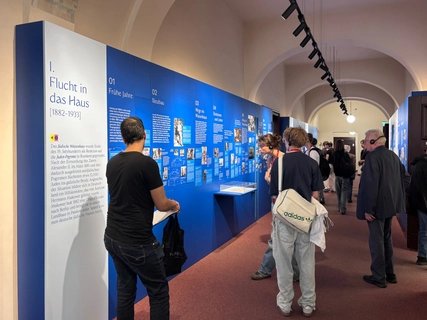
The exhibition presents photographs, personal memories and historical documents; you can hear the voices of the survivors. An audio guide featuring the original voice of eyewitness Leslie Baruch Brent – born Lothar Baruch, a former pupil of the home – leads you through the exhibition. His memories link the chapters with a specific life story.
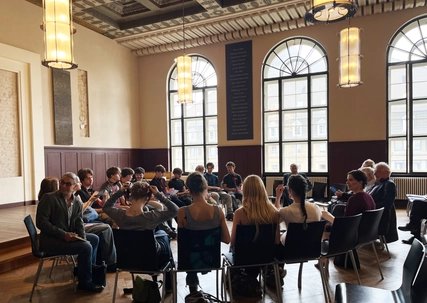
The tour of the exhibition continues on the third floor, where it leads into the Leslie Baruch Brent Hall . This magnificent historic room, , is the former prayer hall of the Jewish Orphanage. This is the space where, at the end of this moving visit to the exhibition, opportunities for encounters, exchange and discussion are offered. You can share your impressions and reflect together on what consequences the catastrophe could and should have for our thinking and actions today . Concerts and readings are also held here regularly, as well as intergenerational ‘Pankow Orphanage Talks’.
SchuleEins
The very same place where the orphans were once taught is now home to a school. SchuleEins is a state-recognised comprehensive school that has firmly embedded the history of the building into its curriculum.
The history of the building
The first Jewish orphanage in Pankow was established in 1882. Hermann Makower, chairman of the Jewish Community of Berlin, offered refuge and accommodation to 39 Jewish boys aged between six and eleven. The children had escaped persecution in the Ukrainian border town of Brody and were on the run. The original building was destroyed by fire in 1911 and replaced by the present-day large and magnificent neo-Baroque structure. The new orphanage was inaugurated as early as 1913.
The boys who were taken in found a vibrant home here across all floors: the ground floor housed classrooms and a dining hall, the upper floors contained the dormitories, and the attic and basement housed the workshops. The prayer room was used for religious services and Jewish festivals, as well as school celebrations. In 1940, the Nazis permanently closed the building, which had long been a home and a safe haven for Jewish children.
Nearby attractions
The historic centre of Berlin, with Museum Island, the Humboldt Forum and Gendarmenmarkt, is within easy reach of the Jewish Orphanage in Pankow. The following attractions are located nearby:
FAQs
How do I get there?
The orphanage is situated in the immediate vicinity of the Pankow S-Bahn and U-Bahn stations and tram stops: S2, S26, S8, U2, M1, 50
Is the exhibition suitable for children?
The exhibition is suitable for adults and schoolchildren
Is the exhibition accessible?
There is barrier-free access to the permanent exhibition via a lift on Hadlichstraße
How much does it cost to visit?
All the activities offered by the Jewish Orphanage, including the audio tour, are free of charge
When can I visit the exhibition?
You can visit the permanent exhibition (excluding the audio tour and prayer room) at the following times; these are subject to the opening hours of the Janusz Korczak Library:
Mon, Tue, Thu, Fri 9 am–7 pm
Wed 1 pm–7 pm
Sat, Sun 10 am–7 pm
For audio tours, group visits including the prayer room and any enquiries, please use the booking form on the website or email kontakt@waisenhaus-pankow.de


