

Alte Nationalgalerie
19th-century paintings and sculptures
At the Old National Gallery in Berlin, you will discover masterpieces by French artists such as Édouard Manet, Auguste Renoir and Claude Monet, as well as famous works from the German Romantic period by great artists such as Caspar David Friedrich and Adolph von Menzel. The collection of classical sculptures is also unique. The museum is part of Museum Island, which has been designated a UNESCO World Heritage Site. The building itself resembles an ancient temple – built in the Prussian Classical style.
From Classicism to Romanticism

As you enter the museum, you are initially surrounded by Prussian Classicism. In the entrance hall and on the first floor, you’ll find yourself amidst sculptures and paintings from this period.
The first floor takes you on to the works of Adolph Menzel. His art is documented in detail here. The tour then continues to the second floor, where you’ll find the Impressionist paintings. Here you’ll stand before famous works of art by artists such as Monet, Renoir and Manet.
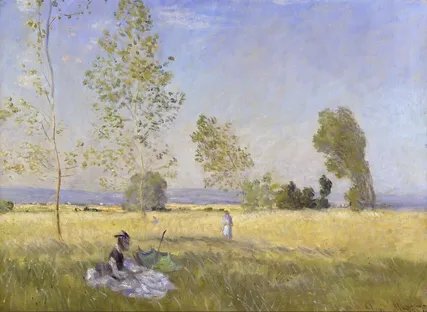
Do allow yourself a little time to admire famous paintings such as Renoir’s ‘In Summer’. The rooms are spacious, with plenty of space devoted to each work of art. On the third floor, you’ll encounter works from the Romantic period and the Goethe era. A highlight for many: the gallery entirely dedicated to the works of Caspar David Friedrich. Stand before his ‘Monk by the Sea’ and let the vast sky work its magic on you.

The history
It is not only the artworks that are significant; the museum itself has an interesting history. It begins in 1861 with the death of a banker. In his will, the banker Wagener bequeathed his collection of paintings to the Prussian state. The condition was that all art lovers should be allowed to view them. Architect Friedrich August Stüler soon began designing a fitting museum for Wagener’s art treasures. Johann Heinrich Strack was the second architect and eventually completed the building. In 1876, the time had come: the museum opened its doors. However, it has not remained open continuously to this day: during the Second World War, bombs and street fighting damaged the building. The gallery was restored, but did not immediately return to its former glory. Germany was divided and the exhibits were scattered across several locations in the GDR and West Berlin. It was not until after German reunification that they returned to their original home. The city renovated the museum once again in the 1990s. It now also features the much-acclaimed gallery dedicated to Caspar David Friedrich. In 2001, the Alte Nationalgalerie reopened its doors and has remained open ever since.
Five famous masterpieces
You shouldn’t miss these works of art:
- Caspar David Friedrich’s painting‘The Monk by the Sea’ (1808–1810)
- Johann Gottfried Schadow’s double sculpture‘Group of Princesses’ (1795–1797)
- the paintings‘The Balcony Room’(1845) and‘Iron Rolling Mill’(1875) by Adolph von Menzel
- Alexander Calandrelli’s bronze equestrian statue of Frederick William IV on the staircase (1875–1886)
- the portrait of a girl,‘In Summer’, by Pierre-Auguste Renoir (1868)
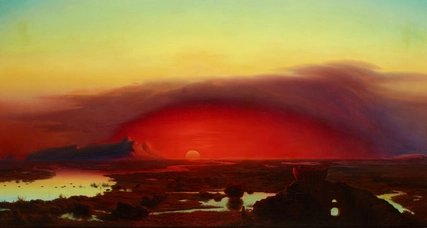
Our tip: Discover a very special painting, presented here exclusively by the Director of the Alte Nationalgalerie:
Places of interest nearby
The Alte Nationalgalerie is one of five art venues on Museum Island. From here, you have a direct view of the Neues Museum. Egyptian artefacts and prehistoric exhibits are on display there, including the bust of Nefertiti. The Pergamon Museum is currently closed; you will be able to visit it again from 4 June 2027. Directly behind it lies the Bode Museum, a magnificent building in the Neo-Baroque style. The collection features works of Byzantine art and sculptures dating from the 10th to the 18th centuries. Late Antique sarcophagi feature alongside statues by Tilman Riemenschneider. The Altes Museum on the Lustgarten houses the Collection of Classical Antiquities: do take a look, for example, at the portraits of Caesar and Cleopatra in the exhibition.
Our tip: Visit the exhibition of Classicist sculptures in the Friedrichswerder Church, practically just round the corner
Your visit
Museum Island is situated in Berlin Mitte. Take the S-Bahn to Hackescher Markt. There’s no car park on Museum Island – you’ll need to use the paid-for spaces in the city centre. It’s best to plan a full day at the museums on Thursdays, as the museums are open until 8 pm. If you fancy visiting all the museums on Museum Island, make use of the Berlin WelcomeCard Museum Island. This allows you to visit all the museums on Museum Island free of charge on three consecutive days (special exhibitions are excluded). If you have the Museum Pass, you can even visit 50 other museums in Berlin free of charge. Admission to the Berlin State Museums is generally free for children and young people up to the age of 18.
Opening hours
| Tuesday | |
|---|---|
| Wednesday | |
| Thursday | |
| Friday | |
| Saturday | |
| Sunday |


