

Martin Maischberger, Director of the Collection of Classical Antiquities
My favourite piece from the collections
The propylon of the Sanctuary of Athena at Pergamon in the Pergamon Museum
One of my favourite exhibits in the Pergamon Museum is the reconstructed entrance gate (propylon) to the sanctuary of the goddess Athena in Pergamon. It will soon be on display again at last:
the world-famous Pergamon Museum is set to celebrate the reopening of a large part of its collection on 4 June 2027.
The Pergamon Museum – a source of fascination
The fascination that the Pergamon Museum holds for visitors has a great deal to do with the incomparable spatial experience it offers: You are literally immersed in the architecture, climbing and sitting on steps, passing through gates, and feeling as though you are right in the middle of an ancient square with its colonnades, temples, altars and statues.
This immersive feeling is particularly striking when you step from the Hall of the Pergamon Altar into the next room: a narrow, low passageway leads from the Altar Hall into the ‘Hall of Hellenistic Architecture’. When you walk up to the larger-than-life statue of Athena and then turn round, you realise for the first time that you have passed through a richly decorated two-storey gateway! The museum building and the exhibit have merged into an inseparable whole.
The entrance gateway to Athena
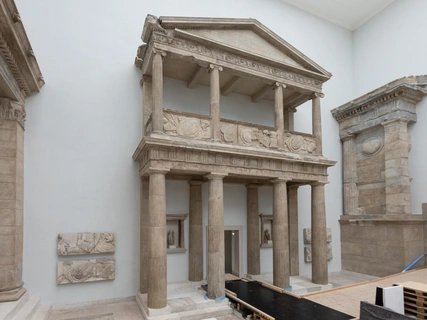
The gateway, with its Doric columns on the lower storey and Ionic columns on the upper storey, dates from the same period as the famous Pergamon Altar next door, namely the first half of the 2nd century BC. The patron was also the same: King Eumenes II (197–159 BC) of the Attalid dynasty, under whom the Kingdom of Pergamon reached its greatest extent and prosperity.
Dedicated to Athena, the Bringer of Victory
The Greek inscription on the entablature above the Doric columns names the patron and the deity in whose honour the building was erected: Athena, the bringer of victory (NIKEPHOROS). The goddess’s epithet, as well as the reliefs depicting weapons between the columns on the upper storey, allude to Eumenes’ victories over his enemies, both the Greeks of neighbouring kingdoms and the Celtic Galatians.
A stunning overall impression
As is the case throughout the Pergamon Museum, this architectural reconstruction is also made up of original elements and modern additions, and it shows only a section of a larger whole. However, it is on a 1:1 scale, preserving the ancient proportions, and is full-height. Even though archaeological and architectural research has yielded new insights here and there since the Pergamon Museum was conceived and opened in 1930, and one or two details must now be regarded as outdated, the overall impression remains overwhelming, compelling and has now become a museum-historical monument of the highest order.
To be experienced once again in June 2027: fascinating ancient architecture at the Pergamon Museum
We have therefore made a conscious decision to preserve and restore this gateway and all the other architectural features in the great halls of the Collection of Classical Antiquities to their original condition at the time of the museum's construction. I am certain that all visitors who will see the Athena Propylon for the first time next year will be just as thrilled as I was as a young archaeology student in 1985!
Dr Martin Maischberger