

Kino International
Cinema icon in new splendour
A true film legend awaits you on Karl-Marx-Allee, having just undergone a fresh new start: the renovation is complete, and the building is once again stylish and ready for big screen moments. Immerse yourself in this special interplay of retro glamour, architectural statement and modern comfort – perfect for anyone who wants to experience their cinema evening not as an afterthought, but as a small event.
Between Strausberger Platz and Alexanderplatz, the first industrially manufactured residential buildings in prefabricated construction were built between 1959 and 1965. The GDR thus broke away from the sugar-baker style of the Stalin era, whose buildings still characterise Karl-Marx-Allee today.
But the socialist residential complex on Karl-Marx-Allee in Mitte was intended to be more than just a place to live. Between 1961 and 1964, it was given its own urban centre: additional buildings for culture and socialising, such as Café Moskau, the Mokka-Milch-Eisbar and the Kino International cinema.
The design for these additional buildings was drawn up by architect Josef Kaiser. As former chief planner of the Stalinist city of Eisenhüttenstadt, Kaiser had been inspired by the Zuckerbäckerstil (confectioner's style) in the early 1950s. Now he was seeking to catch up with developments in the West. The similarity between the Kino International and the latest event venues in West Berlin at the time, the Zoo-Palast and the Deutsche Oper, is unmistakable.
An open house
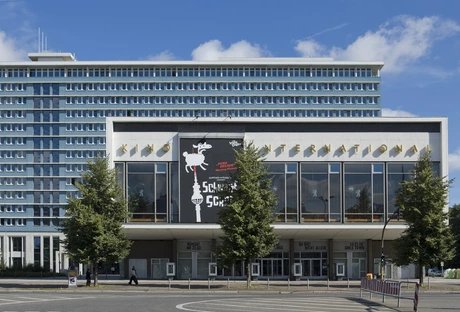
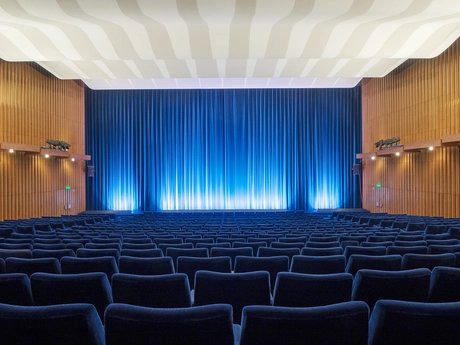
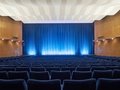
The first floor of the cinema is a real eye-catcher. Without any supporting columns, it rises nine metres above the ground floor façade, giving the impression of floating. The cinema auditorium is also located on the first floor. Originally designed to seat 600 spectators, it offered state-of-the-art equipment when it opened in 1963, including a wide screen in Cinemascope format and acoustics perfectly tailored to the room. For visits by GDR leaders, there is a separate row with extra legroom and even its own nuclear fallout shelter.
The façade of the upper floor is clad with a huge window front – interrupted only by the current film poster, which is still hand-painted today. With the glass façade, Kaiser wants to emphasise the importance of the cinema as an open house for everyone. Everyone should feel welcome – the building has more to offer than just a cinema. During the GDR era, the Klub International youth club organised concerts with new bands. The district library also found a home in the premises.
Image gallery
Kino International
Kino International
Kino International
Kino International
Kino International



Utopia and reality
If you have the opportunity to visit the Kino International, don't just look at the front façade with its panoramic window. Walk around the building. You will notice that the other three sides have no windows at all. They consist of a relief by the artists Waldemar Grzimek, Karl-Heinz Schamal and Hubert Schiefelbein. Their 14 concrete slabs bear the title "From the Life of Today's People", but rather show a utopian vision of the future: an engineer controlling futuristic machines. A heavy labourer whose physical strength is no longer needed and who is therefore studying a book.
The contradiction between utopia and practice is not only evident on the façade. When the SED regime considers films to be too critical, it has them taken off the screens early. Nevertheless, even those in power see some realities at the time: Kino International has to show Western productions in order to finance itself. This leads to an exciting mix of programmes. At the Kino International, award-winning GDR productions such as Solo Sunny celebrated their premieres alongside selected Western films such as Cabaret and Dirty Dancing.
The GDR collapsed in 1989/90, but the Kino International remained. In 1992, the Yorck Group took over the building and still operates it today. European and independent productions are shown here, some of them in their original language. The listed building is also a venue for the Berlinale. Whether Robert Redford, Steven Spielberg, Tilda Swinton or Wim Wenders – the greats of the international film scene have all been guests here at some point.
From the fall of the Wall to Mongay
On the evening of 9 November 1989, the film Coming Out premiered at the Kino International. The title reveals something about the film's controversial content at the time. It follows a young teacher in East Berlin who comes to terms with his homosexuality. During the first of two screenings, the Berlin Wall falls. The audience first experiences a groundbreaking sensation on the screen and later on the streets in front of the cinema. In memory of these events on 9 November, Kino International has been showing a current queer film every Monday since 1997. Mongay is thus the oldest queer film series in Germany.
Our tips for Kino International
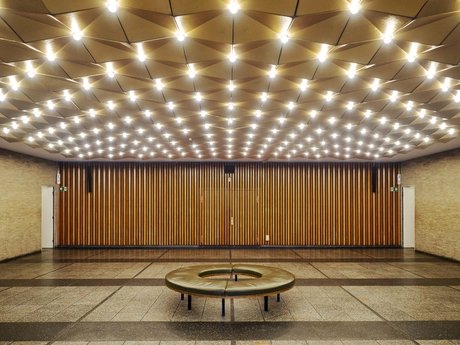
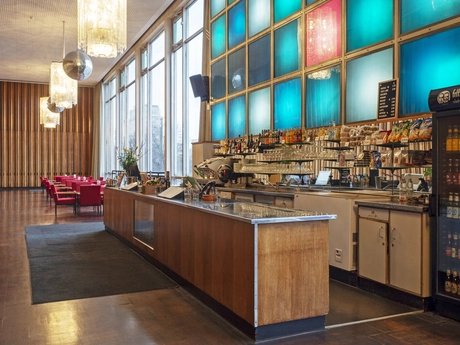
When the newly renovated Kino International reopens, don't miss out on a visit. Before the film, enjoy a drink in the Panorama Bar, where the glass façade offers an excellent view of Karl-Marx-Allee. The International is not only a cinema, but also an event location. Where the GDR leadership once retired after film premieres, events are now held, for example on New Year's Eve. Within walking distance, you can discover other examples of Berlin Modernism from the GDR era: take a look at Josef Kaiser's Café Moskau, the Mokka-Milch-Eisbar and the confectioner's buildings on the former Stalinallee east of Strausberger Platz.
Practical tips from visitBerlin
You can reach the Kino International by taking underground line 5 to Schillingstraße underground station. To explore the city, we recommend the Berlin Welcome Card for public transport.


