

Pergamon Museum
Currently closed - reopening on 4 June 2027
The Pergamon Museum is currently closed for extensive renovation work. On 4 June 2027, the Pergamon Hall with the Great Frieze, the Collection of Classical Antiquities and the Museum of Islamic Art with the Mshatta façade will be on display again.
You can still experience treasures from the Pergamon Museum:
The exhibition“Pergamon Museum: The Panorama”, featuring Yadegar Asisi’s 360-degree panorama and original ancient artefacts from Pergamon, brings the Pergamon Altar to life in its original form on the Acropolis – directly opposite Museum Island.
The Pergamon Altar and world-famous antiquities
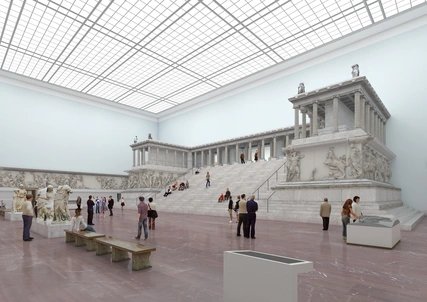
The Pergamon Museum, which is currently closed, houses great cultural treasures: for example, the monumental Pergamon Altar from late Greek antiquity (180/160 BC) with its famous Great Frieze. You will be able to admire it again from 4 June 2027.
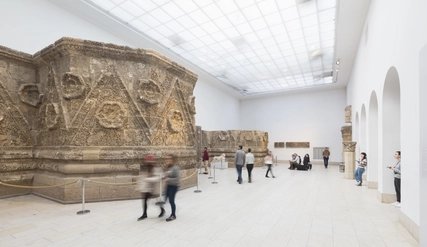
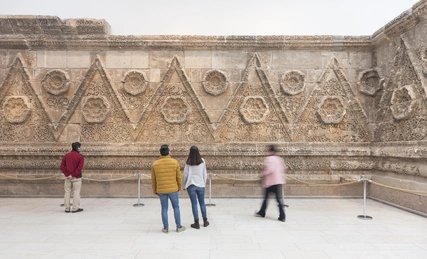
Or the Mschatta façade from a desert residence of the Umayyad caliphs in what is now Jordan, rich in intricate stucco walls. It forms part of the Museum of Islamic Art, which will reopen at the Pergamon Museum on 4 June 2027 .


The Pergamon Museum also houses the Processional Way of Babylon , including the turquoise-shimmering Ishtar Gate, which was built more than 2,600 years ago. These will be on display again in the 2030s.
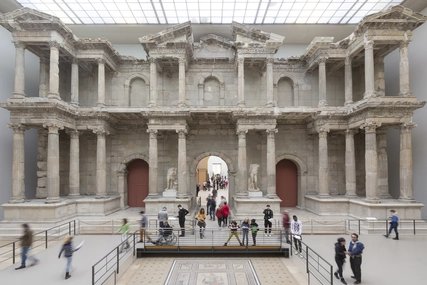
Spectacular: the imposing Market Gate of Miletus, a magnificent example of Roman imperial architecture from what is now western Turkey, featuring two storeys with richly decorated columns, entablatures and pediments. This magnificent structure, too, will not be on display again until the 2030s.
What will be on display again and when?
- Pergamon Hall with the Pergamon Altar: 4 June 2027
- Collection of Classical Antiquities, including large-scale sculptures and Greek and Roman columns: 4 June 2027
- Museum of Islamic Art with the Mschatta façade: 4 June 2027
- Ishtar Gate with the Processional Way of Babylon: 2030s
- Market Gate of Miletus: the 2030s
The history of the Pergamon Museum
After the famous merchant and archaeologist Heinrich Schliemann uncovered Troy, a wave of excavation fever swept through the 19th century. German researchers set off for Pergamon, Miletus, Babylon, Uruk, Assur and Egypt. The Ottoman Empire granted generous terms for the sharing of finds, which is why important architectural monuments, sculptures and small finds were transported to Berlin. Their finds were soon exhibited on Berlin’s Museum Island, in the Pergamon Museum’s predecessor building. But after only a short time, there was no longer enough space. Between 1910 and 1930, the Pergamon Museum was built according to plans by the architect Alfred Messel. It soon came to be regarded as one of the main attractions of the city of Berlin. Alongside the imposing Pergamon Altar – the pinnacle of Hellenistic art – the 17-metre-high Market Gate of Miletus and the magnificent Ishtar Gate form the core of the exhibition.
Nearby attractions
Museum Island in Berlin, a UNESCO World Heritage Site and home to spectacular art treasures, is celebrating its anniversary: the history of this globally unique ensemble of buildings in the heart of Berlin began 200 years ago.
Five major museums are hosting fascinating special exhibitions over the course of five years:
The absolute highlight at the Neues Museum is the famous bust of Nefertiti. The museum also features a faithfully reconstructed Egyptian courtyard, mummies and valuable papyrus scrolls. Right next door, in the Lustgarten, the imposing rotunda dome greets you as soon as you enter the Altes Museum. Behind the columns and sculptures, you’ll find the collection of Roman and Greek sculpture. The Alte Nationalgalerie, meanwhile, is a must-see for lovers of German painting. The focus is on classics such as Caspar David Friedrich and the landscape painter Carl Blechen. You can admire the famous ‘Princess Group’ by Friedrich Wilhelm von Schadow, the sculptor of the Quadriga on the Brandenburg Gate. In the northern part of Museum Island lies the Bode Museum with its striking copper dome. Inside this imposing building, the sculpture collection, the Coin Cabinet and the Museum of Byzantine Art invite you on a fascinating tour.


