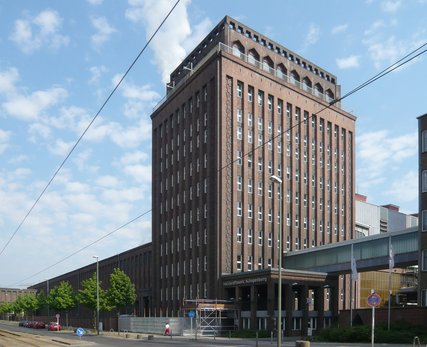
Heizkraftwerk Klingenberg
A living testament to Berlin’s industrial history
In the 1920s, Berlin’s reputation as an ‘electropolis’ was under threat: the power stations were no longer producing enough electricity to satisfy the metropolis’s insatiable appetite for power.
Berlin has been ‘Greater Berlin’ since 1920. The city’s area increased thirteen-fold in one fell swoop to almost 900 square kilometres. Just five years later, the population exceeded four million. This was a challenge even for the world capital of electricity. Power cuts were a recurring problem.
The solution was the Klingenberg combined heat and power plant, Berlin’s first large-scale power station. In a record time of just 15 months, Europe’s most powerful power station to date was built in Rummelsburg. But Klingenberg is more than just a power station. The complex, built in the New Objectivity style, is an outstanding example of Berlin’s industrial architecture. Functionality and modern aesthetics are skilfully interwoven here.
The Klingenberg Combined Heat and Power Plant is now a listed building, but it is not a museum. Just as it was almost a hundred years ago, it is still a power station that supplies Berlin with electricity and heat. And it is a wonderful starting point for an outing to the east of Berlin: in fine weather, for example, Rummelsburg Bay and the Plänterwald await you.
Berlin’s self-sufficiency
Berlin is home to the global electrical giants AEG and Siemens. But by the early 1920s, it had become clear that the city’s own power stations were no longer sufficient to meet demand, and long-distance electricity transmission was too expensive.
The newly founded Berliner Städtische Elektrizitätswerke Aktien-Gesellschaft (BEWAG) sought to counter this and planned two large power stations, one for the western districts in Spandau and one for the eastern districts of the city in Rummelsburg. The construction site in Rummelsburg was an ideal location, conveniently situated on the River Spree with a direct connection to the local marshalling yard.
The power stations are intended not only to provide more energy, but also cheaper energy, thereby boosting the city’s economy. The revenue from electricity sales is, in turn, to benefit the city’s budget. Foreign loans from the USA are making the financing of the construction projects possible. BEWAG has awarded the contract for planning and implementation to AEG.
A Herculean effort by the Klingenberg brothers
Georg Klingenberg was AEG’s leading expert on power stations. He planned the project in Rummelsberg but died before it could be realised. The power station was therefore later named in his honour.
The architects in charge are Georg’s brother, Walter Klingenberg, and his partner, Werner Issel. In 1925–26, they oversee the construction of the new large-scale power station. It is a project involving, at times, 3,000 workers and 100 different companies.
The construction of the machine house was a logistical feat: the 1,500-tonne steel-frame structure was erected in just four weeks.
A milestone of the New Objectivity movement
Almost all the buildings at the Klingenberg power station rest on steel frames. On the facades facing the River Spree, the architects placed great emphasis on aesthetic design. However, these are not ornamentations in the Historicist style designed to attract the viewer’s attention. The power station is an example of New Objectivity architecture.
A particular focal point is the eleven-storey administration tower. Like the Borsig Tower, it features Expressionist elements: the triangular-topped windows on the top floor, the openwork roof finial and the ornamental strips of clinker brick.
The architects also clad the façades of other buildings in red clinker brick. The machine house stands out in particular here, its elongated side facing the Spree adorned with a stately pillared façade. Together with the switchhouse opposite, the machine house spans an entire street. Incidentally, the switchhouse, with its eight striking stair towers, is the only brick-built building in the power station complex.
The eerie fascination of industrial aesthetics
The rear sections of the plant, which cannot be seen by observers from the river, openly reveal their function. Nothing here conceals or cladders the steel factory buildings. An aesthetic that impressed contemporaries, but also had an almost intimidating effect. In 1929, the trade journal *Die Form* wrote the following about the Klingenberg power station:
‘… this is the uncanny aspect of these structures: that they generate and contain forces against which their mechanical function pales into insignificance, serving merely to produce them – forces that our imagination cannot comprehend. From the perspective of the human sense of form, this is where the incomprehensible, yet inspiring, nature of this form begins.”
The pride of the city of Berlin
The Klingenberg power station has a capacity of 270 megawatts. Since 1928, it has been covering two-thirds of Berlin’s electricity needs. The ‘electropolis’ is secure.
But that is not all. The city of Berlin is proud of its new industrial plant. On advertising posters, it appears as a tourist attraction alongside the Brandenburg Gate, and at the 1929 World Exhibition in Barcelona, it was a highlight in the German electricity industry’s pavilion.
Right up into the 1930s, groups from the city centre would come several times a day to take a guided tour of the new power station. An open-air swimming pool in Rummelsburg, heated using waste heat from the power station, also attracted a great deal of admiration.
The impact
Despite its efficiency, the Klingenberg power station also posed a burden on local residents. The plant was fuelled by lignite from the Lusatia region. Smoke and soot particles polluted the air. In 1931, the company management installed electrostatic precipitators in the chimneys.
In the GDR, the operators erected two new large chimneys in the 1960s, designed to curb emissions. Standing over 140 metres tall, they have defined the appearance of the power station ever since.
The rear factory buildings, including the boiler houses and the coal preparation plant, were replaced by modernised facilities over the following decades. The more imposing buildings have been preserved to this day, particularly the administration tower, the machine room and the switchhouse.
The industrial monument is still a power station
In 2006, the Swedish Vattenfall Group took over the Klingenberg power station. It continues to supply hundreds of thousands of Berlin households with electricity, although this is no longer generated from lignite. Since 2017, the power station in Rummelsburg has been using more environmentally friendly natural gas. It is also a combined heat and power plant, meaning it generates not only electricity but also heat through combined heat and power generation.
Our tips for visiting the Klingenberg combined heat and power station
As the Klingenberg CHP plant is still an operational power station, you are unfortunately unable to visit the inside. However, do take in the grandeur of this modern industrial architecture and then enjoy a change of scene: if the weather is fine, it’s well worth taking a trip to the Plänterwald on the other side of the Spree. There, you can take a guided tour of the Spreepark [https://gruen-berlin.de/spreepark/besucherinformation-0/fuehrungen], once the only amusement park in the GDR. Boats are available for hire in Rummelsburger Bucht. Incidentally, you’ll discover a monument to industrial architecture from the GDR era if you take tram line 21 one stop south: the Funkhaus Nalepastraße is also a building in the New Objectivity style. If you book in good time, you can enjoy a guided tour of the original interior there.
Practical tips from visitBerlin
The best way to get to the Klingenberg CHP plant is to take tram line 21 to the ‘Heizkraftwerk’ stop. To explore the city, we recommend the Berlin WelcomeCard for public transport.