

Stefan Weber, Director of the Museum of Islamic Art at the Pergamon Museum
My favourite piece from the collections
The Aleppo Room at the Museum of Islamic Art at the Pergamon Museum
I lived and carried out research in Syria for many years and visited hundreds of houses: the Aleppo Room is unique. Dating from 1601–1603, it is the oldest and most artistically valuable wall panelling from the Ottoman Empire. It will soon be on display again at last:
The world-famous Pergamon Museum will celebrate the reopening of large parts of the museum on 4 June 2027.
A feast for the senses
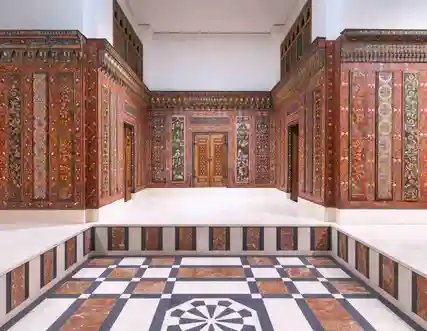
The rich visual programme and the finely calligraphed texts provided ample subjects for cultured entertainment. Thus, depictions of wrestlers and jugglers entertain us. Magnificent peacocks, birds of paradise and other animals bring the walls to life. Chinese-looking mythical creatures, such as the mystical bird Simurgh – depicted as a phoenix – or a winged lion-dragon, lead us into a fantastical animal world. The eye is also drawn to Christian and biblical themes: the Last Supper, Mary with the Child in the Temple, the Sacrifice of Isaac and much more. The panelling originates from the reception hall (qa’a) of the broker named in the inscription, Isa ibn Butrus (Jesus, son of Peter).
Aleppo: a crossroads of trade routes for millennia
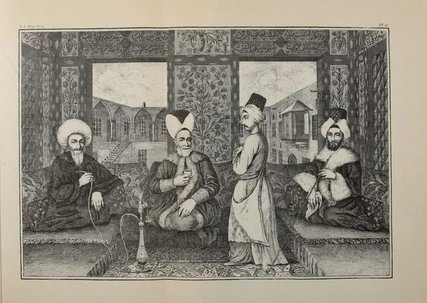
Aleppo, perhaps the oldest continuously inhabited city in the world, was a crossroads of various trade routes for millennia. Christians of almost every denomination also lived in the sprawling alleyways lined with impressive houses. Every respectable house in Syria had a courtyard and a room for visitors. After a long day in the dry heat, such a leafy courtyard – with the sound of water from fountains, the scents in the air and the chirping of swallows – was always a place of relaxation and contemplation for me too.
The only fully preserved panelling
The panelling in Berlin was legally purchased in 1912 and is the only fully preserved painted panelling from Aleppo known to us. The house itself was severely damaged during the Battle of Aleppo (2012–16) and by an earthquake (2023). The Museum of Islamic Art, together with its Friends’ Association (FMIK e.V.), has recently restored the building. Since 2013, Syrian and German researchers at the museum have been documenting Syria’s cultural treasures.
Prof. Dr Stefan Weber