

Riehmers Hofgarten
The story of a persevering master bricklayer
Amidst all the typical Berlin tenement blocks in Kreuzberg, Riehmer built his courtyard garden as a pleasant, peaceful place to live.
The young master bricklayer Wilhelm Ferdinand August Riehmer was swimming against the tide at the time. Instead of pushing ahead with the construction of more tenements with dark inner courtyards in Kreuzberg, he took the risk of erecting a swanky ensemble of buildings complete with an inviting courtyard garden. It's still worth taking a look at today, come and see it.
The inventor of Wohnhofstraße
He is a man who wants to do something different. And quite successfully at that. In the second half of the 19th century, as more and more people came to Berlin, tenement blocks conquered the city. The aim of many profit-orientated urban planners was to accommodate many people in the smallest of spaces. The only requirement is a minimum courtyard size of just under 26 square metres. Hardly any light and air for the many residents of such apartment blocks.
Not so with Riehmer: his buildings are designed to provide people with quality of life. So the smart master builder embarks on the project of his life. It took courage, a lot of labour and a long construction period, but it was definitely worth it. Riehmer is regarded as a pioneer of the Wohnhofstrasse. His prime example, Riehmer's Hofgarten, still stands today in Berlin-Kreuzberg on the corner of Yorkstrasse and Großbeerenstrasse and Hagelberger Strasse.
The development of the buildings
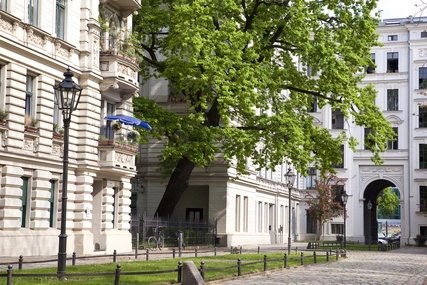
Between 1881 and 1899, Riehmer realised his dream of quiet and pleasant living in the big city. He built 18 residential buildings, each with 5 storeys, on his plot of land, which was bounded by three streets, as well as a park-like inner courtyard for relaxing. As was customary at the time, the larger flats faced the street. While the smaller flats, which also had at least 3 rooms, faced the courtyard. In order to attract well-heeled tenants, the external appearance also had to be right, of course. More precisely, the façade. Elements ranging from late classicism to neo-baroque adorn the building complex, which was built over 20 years ago. The garden area is also attractively designed with a 5 metre high bronze sculpture by the sculptor Gerson Fehrenbach. The park-like inner courtyard can be reached via magnificent portals.
One of the 100 most important buildings in Berlin
Riehmers Hofgarten was not immune to the consequences of the war. The left wing was completely destroyed in the Second World War and never rebuilt. Nevertheless, the building from the Gründerzeit period was listed as a historical monument in 1953 and the façades were restored ten years later. Today, the popular Kreuzberg address is home to offices, doctors' surgeries, cinemas and a hotel. When Wilhelm Riehmer's first building design was rejected, he himself probably hardly believed that it would one day become a valuable ensemble of buildings in Berlin: After all, the ensemble is one of the 100 most important buildings in Berlin.