

Deutsche Kinemathek
At the new location in E-Werk Berlin
Discover the history of German cinema in the new exhibition ‘Screentime’ – from its beginnings to the present day!
Visit the "Screentime" installation at its new location, the E-Werk Berlin
With"Screentime", the Deutsche Kinemathek is presenting itself at its new location in the E-Werk, the former substation in Berlin-Mitte. The historic hall, reaching dizzying heights, has been transformed for the first time into a large-scale, exciting media space. The multimedia installation showcases highlights from 130 years of film and television history and inspires you to rediscover moving images as part of our culture and perception.
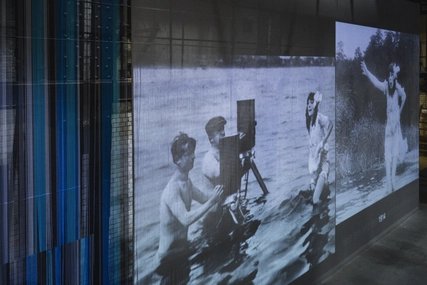
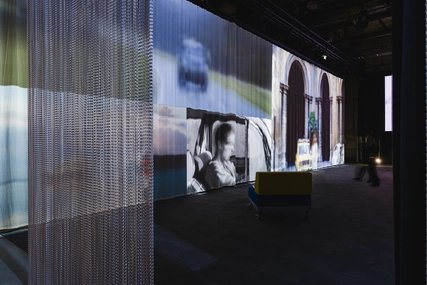
Unforgettable iconic film scenes, photographs and objects such as costume designs for Marlene Dietrich, historical star postcards and masks from Fatih Akin's film "Rheingold" from the museum's own extensive collection have been combined to create an interactive, space-filling installation. Floating gauze surfaces, video installations and projections create a very special atmosphere in the approximately 600 square metre exhibition space.
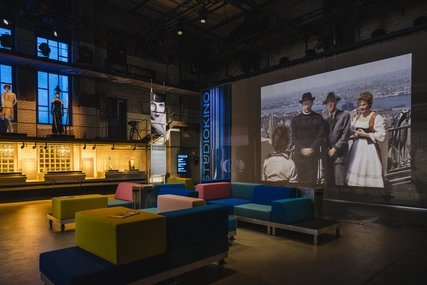
Critical, playful, sensual
Behind it all is the question: How are images created and what stories do they tell? "Screentime" raises important questions about the creation, meaning and preservation of film and makes it clear that the history of moving images is an ongoing process – multi-layered, fascinating and full of contradictions.
The accompanying programme of screenings, workshops and talks, a changing selection of films in the studio cinema and various educational offerings make the Kinemathek im E-Werk a place for exciting, dynamic media experiences – critical, playful and sensual.
The foundation and its offerings
The Deutsche Kinemathek – Museum für Film und Fernsehen foundation is one of the leading institutions in Europe. Its mission and goal is to preserve and communicate audiovisual heritage. The E-Werk Berlin is a new, temporary home in its long history – until the completion of a new planned film centre. It presents experimental exhibitions, curated film series, productions from the television archive and the Film Restored festival. Anyone interested is also invited to take part in a varied programme of educational activities and events. In addition , there are archives and a specialist library to support science and research.
The history of the Kinemathek: from Metropolis to The Blue Angel to contemporary film
The Deutsche Kinemathek was founded in 1963 as a film archive by director Gerhard Lamprecht. His collection forms the basis of the archive. In 2000, the Kinemathek moved to the Filmhaus on Potsdamer Platz, where the extensive collection found a home in a museum. With the establishment of a television museum six years later, the Deutsche Kinemathek – Museum für Film und Fernsehen (German Film Archive – Museum for Film and Television) was finally created. The exhibition focuses on German film. It also displays the estates of German actors and filmmakers such as Heinz Rühmann and, in particular, Marlene Dietrich. On 23 January 2026, the Deutsche Kinemathek opened its doors at its new location.
History
From the 1930s onwards, Marlene Dietrich enjoyed success first in Berlin and later in Hollywood. Her appearances in men's suits and androgynous poses are legendary. The most beautiful objects from her private estate and many of her famous costumes, including the famous swan coat and men's suit, are preserved by the Deutsche Kinemathek. Memorabilia such as letters and her rag dolls, which accompanied her on all her travels, provide an insight into her private life. The Kinemathek has early film highlights that have lost none of their fascination and charisma over the years: for example, Fritz Lang's silent film Metropolis from 1927, the first feature-length science fiction film. It tells the story of film under National Socialism and artists in exile, the idealised world of post-war cinema, and more recent successful films such as Run Lola Run and The Lives of Others.
Highlights of the current exhibition
- Scenes from classics such as "The Cabinet of Dr. Caligari" on giant screens
- East German film scenes, e.g. from Coming Out or Solo Sunny
- Costume designs for Marlene Dietrich
- Interactive media stations for film and television clips
- Picture collages on the west side of the exhibition hall


