

Neues Museum
Nefertiti, Egypt and Classical Antiquity
As one of the museums on Berlin’s Museum Island, the Neues Museum showcases the cultural history of Egypt, antiquity, and prehistory and early history.
Nefertiti
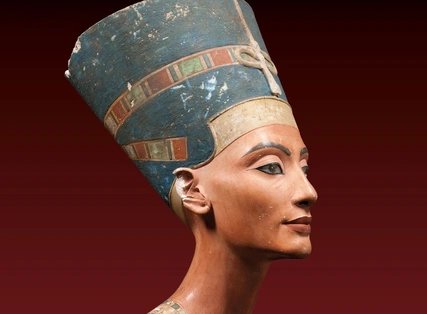
The neoclassical building houses 9,000 objects from significant collections. Embark on an enlightening journey of discovery and explore works of art from prehistory and early history. Pay a visit to the museum’s Egyptian collection and the papyrus collection. Standing before the museum’s main attraction, the bust of Nefertiti, you can feel the fascination of ancient Egypt. This masterpiece of ancient sculpture, graceful and majestic, is displayed in theNorth Dome Hall. As the only object in the room , the Nefertiti bust makes a truly striking impression.
Unique works of art
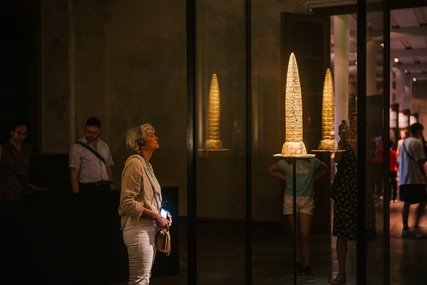
Today, this major visitor attraction brings together objects from the Egyptian Museum and the Papyrus Collection, the Museum of Prehistory and Early History, and exhibits from the Collection of Classical Antiquities. Across some 8,000 square metres and four levels, you can marvel at around 9,000 exhibits. For example, follow in the footsteps of the ancient Egyptians through the restored sacrificial chambers in the basement. The famous Berlin Green Head, dating from around 400 BC, is one of the artefacts that illustrates the evolution of humanity over the centuries. High ceilings, round arches and faithful reproductions of frescoes provide the perfect setting for the exhibits. In 2014 , the permanent exhibition ‘Back to the Stone Age’ was added . Bronze Age. Iron Age ’ on the third level. Since then, the famous Bronze Age gold helmet has been on display here in all its splendour. The 74-centimetre-high hat looks particularly mysterious in the centre of the circular ‘Star Hall’. Next, embark on a journey into the world of archaeology: the ‘Red Hall’ displays artefacts from finds dating up to the late 19th century in several display cases. Information panels illustrate the methods used in excavations both then and now. You will then come to a model landscape by the river. This takes you through the millennia and illustrates how its inhabitants developed over time. Your tour ends in the Stone Age Hall.
Spectacular museum building
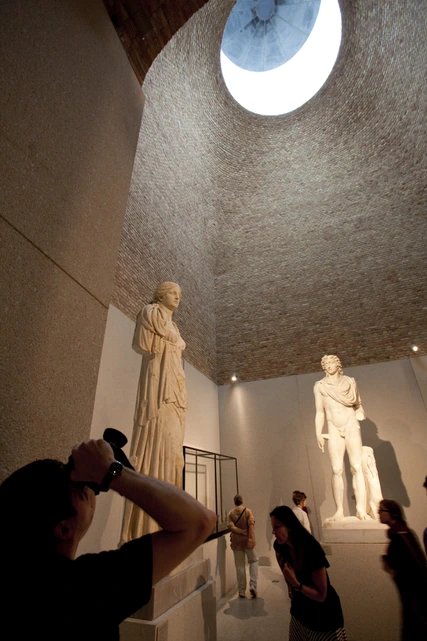
The meticulously restored premises create a unique atmosphere blending classicism and modernity. It is no coincidence that this imposing building ranks among the most significant museum buildings of the 19th century.
Friedrich August Stüler, a proponent of Classicism and a pupil of Schinkel, built the Neues Museum in the mid-19th century. It initially served as an extension to the Altes Museum. After the Second World War, the Neues Museum remained closed due to extensive damage. Then, in 2009, the time had finally come: the museum reopened its doors. The British star architect David Chipperfield did not simply rebuild the building, but added his own, understated elements to the restored historic sections. Particularly impressive is the grand staircase hall with its brick-clad walls and a concrete staircase.
The highlights
- the portrait bust of Queen Nefertiti
- the famous ‘Green Head of Berlin’ from the Late Period
- precious silver vessels from the Treasure of Priam
- The well-preserved, 74-centimetre-high ‘Berlin Gold Hat’ from the Bronze Age
- a 700,000-year-old hand axe from the Palaeolithic period, the museum’s oldest exhibit
Nearby museums
You are right in the heart of the famous museums on Museum Island. Visit the Alte Nationalgalerie, situated right next to the Neues Museum. Inside this imposing building, you’ll find significant works of art from the 19th century. These range from Impressionism to Realism, including masterpieces by the painter Paul Cézanne. Afterwards, continue your stroll across Museum Island to the nearby Bode Museum. There you’ll find Byzantine artworks, sculptures from the Middle Ages to the early 18th century, and the Coin Cabinet. In addition to the Neues Museum, David Chipperfield also designed the James-Simon-Galerie, the spectacular exhibition building on Museum Island.
Your visit
The Neues Museum is centrally located on Museum Island. You can easily reach it on foot from Hackescher Markt S-Bahn station. S-Bahn lines S5, S7 and S75 serve the station. Alternatively, you can take bus 100 or 200 and get off at the Lustgarten stop. If you fancy visiting the museums on Museum Island, make use of the Berlin WelcomeCard Museum Island. This allows you to visit the museums on Museum Island free of charge for three consecutive days (special exhibitions are excluded). If you have the Museum Pass, you can even visit 50 other museums in Berlin free of charge. Admission to the State Museums of Berlin is generally free for children and young people up to the age of 18.
Opening hours
| Tuesday | |
|---|---|
| Wednesday | |
| Thursday | |
| Friday | |
| Saturday | |
| Sunday |


