

Underground Stations of Berlin Modernism
Why some of Berlin's most beautiful underground stations are located in Spandau
The 1980s were colourful, playful and sometimes garish - and this also applied to the architecture. No wonder that some of Berlin's most fascinating underground railway stations were built during this period.
The rattling of the arriving underground train. People streaming out of the train and making their way to the exit. Others waiting on the platform or taking a seat on one of the benches. The familiar warning signal when the doors close.
Most people travelling in the capital will sooner or later find themselves in one of Berlin's underground stations. Regardless of whether you are a resident commuting to work in the morning or a visitor to Berlin travelling between sights: You will spend your time waiting for the yellow carriages of Berlin's public transport system in one of the 173 underground stations.
Works of art in unexpected places
Together, the stations form a (largely) underground network of junctions, connected by almost 150 kilometres of track. A kind of invisible lifeline for the city that takes everyone wherever they want to go. For many passengers, the stations are purely functional places where they wait for their underground train. Once they arrive at their destination, they immediately look for the exit so that they can quickly return to daylight.
If you don't look around, you miss a lot. After all, Berlin's modernist underground stations are works of design and architectural art in public spaces. More than half of them are now listed buildings.
Stations built at the beginning of the 20th century, such as Wittenbergplatz or Deutsche Oper, have long been on the list of Berlin's transport monuments. They were designed by the Swedish architect Alfred Grenander and impress with their elegant forms.
However, it is not only railway stations with neoclassical elements or steel columns that are now considered worthy of protection: since the end of 2018, seven underground stations on underground line 7 between Siemensdamm and Rathaus Spandau have also been included on the list. Their unusual design is an impressive example of postmodern construction in Berlin's underground.
And the perfect end to a very special underground railway line:
The most colourful tunnel in the world leads to Spandau station
Colourful tiles, metal columns, ceramic decorations: since the beginning of Berlin's underground architecture, each station has had its own unique look. No two stations are the same, so that every passenger immediately recognises where they are from the design.
One of the best examples of this right from the start is the U7 underground line, which runs from Rudow in the east of the city to the west. As the longest underground line in Berlin with a history stretching back over 100 years, its 31.8 kilometres invite you on a special kind of journey through time.
The design of each station reflects the spirit of the times when it was built. And this becomes more and more experimental with every station heading west. The fact that the U7 underground line can be considered the most colourful tunnel in the world is thanks to one man in particular.

The man who made the Berlin underground colourful
Rainer Gerhard Rümmler took up his post as head of the design department of the West Berlin Building Department in the early 1960s. For the next thirty years, he shaped the face of Berlin's underground as an architect. At the beginning of his career, he often used colour as the most important design element in his underground stations.
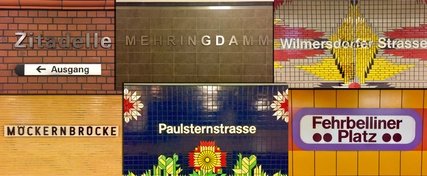
Intense tones such as the bright, dark orange-coloured tiles in Yorckstraße underground station (which had to make way for a renovation in 2016) or the sunny yellow tiles in Möckernbrücke underground station.
A journey on the U7 underground line is also a journey through time through Rümmler's development as an architect. From the 1960s to the 1980s, he extended the line in the direction of Spandau. The further west the journey takes him, the more clearly his signature style becomes recognisable. For Rümmler, an underground station should first and foremost be an "unmistakable place". That is why he increasingly takes the surroundings of the stations into account and incorporates them into his design, initially in a very restrained manner.
Some symbolism is only recognisable at second glance. For example, the dark green metal plates at Eisenacher Straße underground station symbolise the green of the Thuringian Forest near Eisenach. Or the colours used at Konstanzer Straße underground station refer to the coat of arms of the city of Constance. However, the allusions were not to remain so subtle, as a new trend began to influence architecture in the 1980s: the era of postmodernism was dawning.
End of the line postmodernism
A colourful mix of styles, colours and shapes: in the last quarter of the 20th century, postmodern architecture broke with the strict, functionalist design of the previous decades. This development did not even stop at Berlin's modernist underground stations.
Rainer Gerhard Rümmler himself lives in Spandau. During the long-awaited extension of the U7 underground line towards Spandau in the early 1980s, he took the opportunity to give each station a very individual look. Above all, he used his architecture to create references to the places above ground. This is entirely in keeping with the spirit of the postmodern era: historical allusions and symbolic forms are now an important part of the architecture.
Rümmler makes a local reference in almost all of the seven underground stations between Siemensdamm and the town hall. But this time even more clearly than in the stations of the 1960s and 1970s. He emphasises typical local features that sum up his idea of an unmistakable underground station.
Image gallery

U-Bahnhof Siemensdamm, Linie U7 Berlin

U-Bahnhof Rohrdamm, Linie U7 Berlin
U-Bahnhof Paulsternstrasse, Linie U7 Berlin

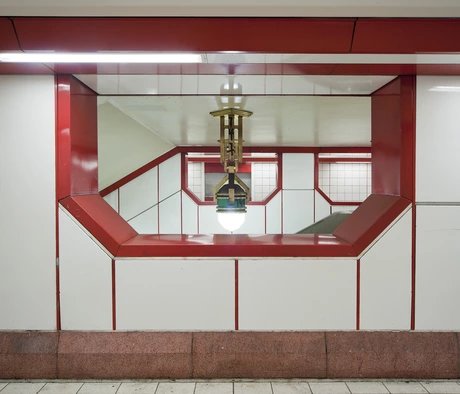
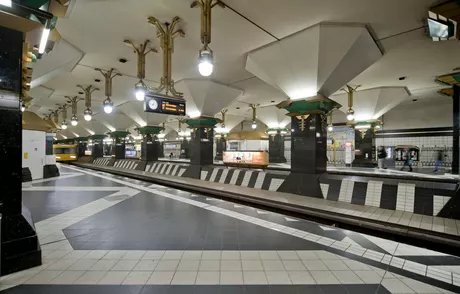



Underground stations that tell Berlin's stories
- Take a ride along the line towards Spandau and take a close look around each station. At the Siemensdamm underground station, the company that gave the station its name is clearly at the centre of the design. Even the font of the station name is based on the Siemens brand logo. The walls are decorated with historical illustrations that refer to Werner von Siemens' most important achievements.
- The Rohrdamm underground station is also still characterised by the nearby Siemens factories: stylised images of machine parts with cogwheels symbolise the proximity of the industry.
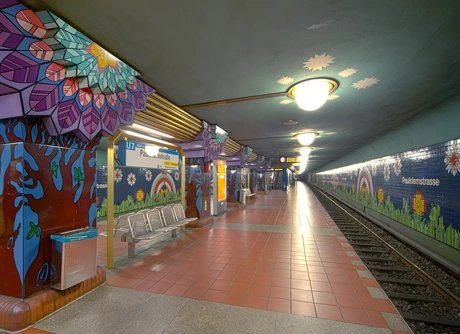
- Things get really colourful at Paulsternstraße underground station. Here you can see white and red tile mosaics of flowers on a dark blue background. The pillars in the middle of the platform are designed as trees with huge colourful semicircles of flowers at the top. At first, Rümmler finds it difficult to find a local reference here too. Then the underground railway architect thinks of the former inn in the area, which was named after its owner Paul Stern. The underground station symbolises what a guest would see when passing through: flowers, meadows, trees and, at night, the starry sky.
- Haselhorst underground station looks rather sober in comparison. With the tin ceilings and metal-clad pillars, Rümmler makes a reference to the local metal industry.
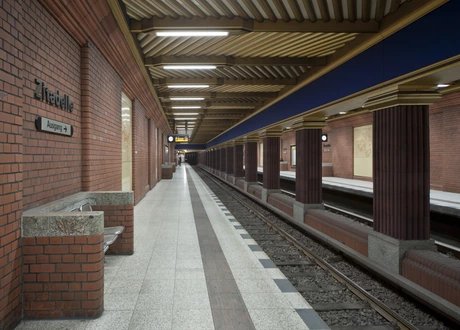
- This is followed by the Zitadelle underground station. Here, Rümmler picks up on the architecture of the Spandau Citadel: he clad the walls with red bricks reminiscent of the 16th century fortress walls.
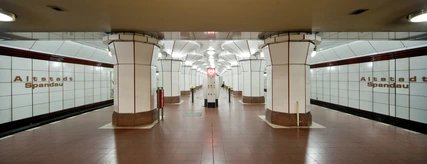
- The last two stations on the route are particularly impressive: in the Altstadt Spandau underground station, the wide, white-clad columns create a cathedral-like atmosphere. The underground architecture is thus reminiscent of the nearby St Nicholas' Church. The crowning glory is the Rathaus Spandau station. Countless small lamps on the ceiling, green and gold decorative elements on broad black granite columns: the architecture of this underground station revels in the postmodern interplay of historical architectural quotations.
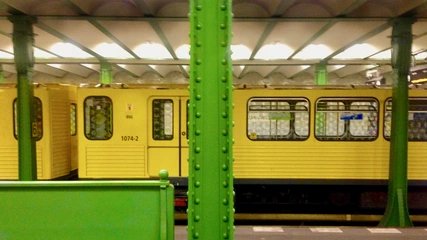
The perfect embodiment of postmodernism
Among Berlin's modernist underground stations, the stations between Siemensdamm and Rathaus Spandau are among the most beautiful and unique. They are very different from Alfred Grenander's elegant early stations, such as Wittenbergplatz or Deutsche Oper. But also from future railway stations such as Unter den Linden or Rotes Rathaus.
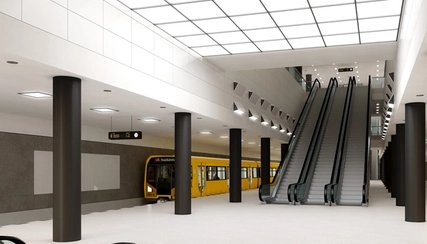
These stations on underground line 5 have a futuristic design and are decorated in bright, neutral colours. Rainer Gerhard Rümmler's stations, on the other hand, are colourful, symbolically charged and do not shy away from kitsch. As such, they perfectly embody the postmodern zeitgeist.
Our tips on the topic
- If you want to find out more about the history of the Berlin underground, visit the Berlin Underground Museum. It is located in the former Olympiastadion signal box and exhibits historical ticket machines, service clothing and maintenance equipment, among other things.
- You can also learn more about structural features, tunnelling methods and the history of the Berlin U-Bahn on a ride in a U-Bahn convertible.
- You can book historical tours of individual underground stations at Berliner Unterwelten.
- If you would like to find out more about Rainer Gerhard Rümmler's work, we recommend the publication "Der Himmel unter West-Berlin: Die postsachlichen U-Bahnhöfe des Baudirektors Rainer G. Rümmler" by Verena Pfeiffer-Kloss, which was published at the beginning of 2019.

