

Marion Ackermann, President of the Stiftung Preußischer Kulturbesitz
My favourite piece of the collections
‘The Rumpf Family’ by Lovis Corinth
Given the sheer abundance and diversity of the collections, it’s really not easy to answer the question of which is my favourite piece. I’ll give it a go anyway and choose the painting ‘The Rumpf Family’, which Lovis Corinth painted in 1901 and which has been on display in the Alte Nationalgalerie since 1909. For me, it is a very special painting; thanks to its atmosphere of colour and light, I never tire of looking at it, and I keep discovering something new in it – sections that are pure colour painting and almost abstract.
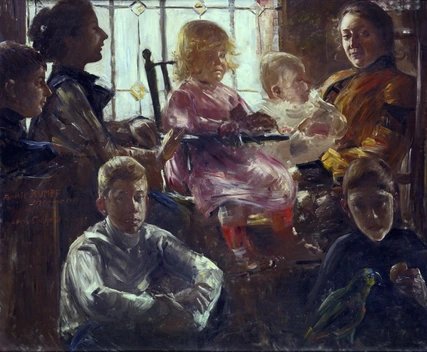
Complex family dynamics in the interplay of light and shadow
The family portrayed belonged to a circle that helped shape cultural life in Berlin and Potsdam around 1900. Their home was a meeting place for artists, writers, scholars and architects. Lovis Corinth was a regular guest there. He painted the family of his friend, the landscape and architectural painter Fritz Rumpf, in the dining room of their Potsdam villa: Elisabeth Rumpf with her six children.
And he did so in a style quite different from how family portraits were usually painted at the time: the figures are positioned in front of a window, backlit, creating an atmospheric interplay of light and shadow. In the centre sits a little girl in a pink dress; the two children on the left are looking conspicuously to the right, their profiles visible; a daughter at the bottom right is feeding her green parrot a biscuit; the mother and a son are looking at us scrutinisingly; the father is not visible at all.
An insight into a dynamic family dynamic
Here, Lovis Corinth has succeeded in capturing a highly vivid and multi-layered insight into a dynamic family dynamic. For me personally, the ‘secret’ star of the painting – the girl in the pink dress – also serves as a reminder that children have not yet acquired social markers and reflect emotions with the utmost intensity. Shortly before this family portrait was painted, Ellen Key’s book *The Century of the Child* had been published , which went on to become an absolute bestseller at the turn of the century.
Corinth, Cassirer and Impressionism
It was not only the composition and the subject matter, but also the way it was rendered on the canvas that was something new for Corinth’s contemporaries: The sketch-like style, the visible brushstrokes, the spontaneity and the focus on specific details – all so typical of Impressionism – initially challenged the public around 1900. The fact that this new artistic movement also found admirers in Germany is partly thanks to Paul Cassirer , who helped German Impressionism achieve its breakthrough. Cassirer was one of the most significant art dealers and gallery owners of his time – and was among Lovis Corinth’s most important patrons. ‘The Rumpf Family’ was on display at Paul Cassirer’s Kunstsalon as early as 1902–03. A few years later, the painting was acquired for the National Gallery and has been part of the collection since 1909.
The exhibition *Cassirer and the Breakthrough of Impressionism*, which runs until 27 September 2026 at the Alte Nationalgalerie, is dedicated to Paul Cassirer’s commitment.
The history of this painting serves as a reminder that art always needs people to discover, promote and bring it to the fore.
Why this painting?
Lovis Corinth demonstrates the possibilities of portraiture in a visually thrilling way, from full face, three-quarter profile and full profile; whilst skilfully interweaving them with various lighting effects: from backlighting, which makes the profile stand out, to modelling light from the side or in partial shade.
In terms of content, it appears as a ‘family constellation’, the entire dynamic of a family condensed into a single image within the most confined of spaces. The painting depicts a private family moment which, in all its complexity and despite its unique qualities, conveys a sense of the universal. I am reminded of Tolstoy’s aphorism from *Anna Karenina*, though I cannot decide whether the Rumpfs belong more to the category of ‘unhappy families’ or rather to the happy ones, which are all alike – probably both.
Corinth’s work also speaks to the sensual power of Impressionism and how the passion for art held by individual people helps it to take its rightful place.
Prof. Dr. Marion Ackermann