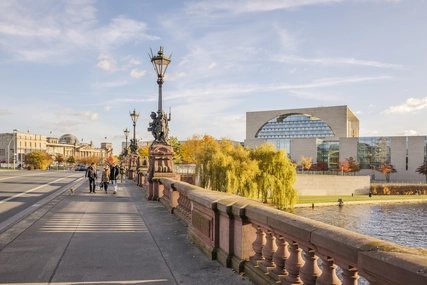
Bundeskanzleramt
Political transparency for the citizens
The Bundeskanzleramt (Federal Chancellery) in Berlin embodies the idea of an open and transparent democracy like few other buildings. Located directly next to the Reichstag, it combines modern architecture with political symbolism and is a defining feature of Berlin’s government district. As the largest government headquarters in the world, it is not only the workplace of the Federal Chancellor, but also an architectural statement representing dialogue between politics and the public.
Bright and open, transparent to citizens – this is how the Federal Chancellery at the Reichstag presents itself. While the opulent Reichstag building only gained the lightness that characterises it today through its glass dome, the Federal Chancellery was designed with transparency in mind from the outset.
History of the Chancellery
The spectacular building ensemble of the Federal Chancellery in Berlin was designed by Berlin architects Axel Schultes and Charlotte Frank during Chancellor Helmut Kohl's term of office (1982–1998). It is one of the most impressive buildings in the newly created government district. In fact, it is the largest government headquarters in the world – eight times larger than the White House.
When the Bundestag decided in 1991 that Berlin should be the capital of reunified Germany, a competition was launched for the architectural design of the federal government buildings in the Spreebogen. Construction of the Chancellery began in 1997, and it was occupied in 2001.
Architecture of the Federal Chancellery: glass and light
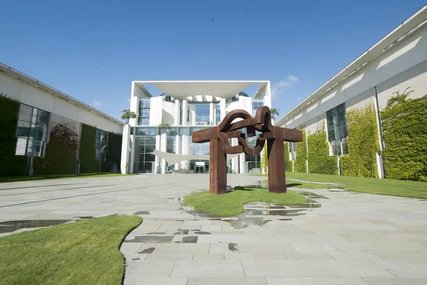
The Chancellery, which is integrated into the Band des Bundes ( ), consists of a nine-storey central building, the administration building, as well as lower, elongated wings and large windows. The administration building is characterised by the 18-metre-high semicircle in the upper part of the façade. Some people therefore refer to it as the "Federal Washing Machine". The Paul Löbe House and the Marie Elisabeth Lüders House are also part of the ensemble of government buildings on the Spree.
The building is designed in the postmodern style. The glass façades of the Federal Chancellery convey one thing above all else – transparency: twelve-metre-high, softly shaped steles, which at first glance appear to be columns, structure the glass façades and windows and create perspectives in which the interior and exterior of the building merge, symbolising the contact between politics and the outside world.
The Office of the Federal Chancellor
The Federal Chancellery is the seat of the federal authority and also the office of the Federal Chancellor, where he or she holds cabinet meetings. Inside the Chancellery, the offices of the staff are located in the side wings, while the main building serves as a representative function. The entrance hall is the size of a cathedral. With its transparent window design and balconies, the reception level offers a wonderful view over the Tiergarten park.
All former chancellors are gathered on the first floor, where their portraits hang. Chancellors often choose great artists to paint their portraits: Jörg Immendorf painted Gerhard Schröder, Bernhard Heisig captured Helmut Schmidt.
In the courtyard of honour, where state guests are received, stands the monumental iron sculpture Berlin by Spanish artist Eduardo Chillida.
Guided tours of the Federal Chancellery
The Chancellery in Berlin is not open to visitors. However, you can take a look behind the scenes and view the building from the inside on the German government's YouTube channel. You can also find detailed information on contacting the Chancellery and the German government on the German government's website.
Every year, there is an open day when the Federal Chancellery is open to all citizens with guided tours.
Sights near the Chancellery