
There is no better place to experience democracy than in Berlin. During September, there are over 200 events and workshops focusing on Democracy Day.
Throughout the year, the city hosts a wide range of exhibitions and activities exploring democracy and politics. You can also attend public parliamentary sessions by prior arrangement, join guided tours of the Reichstag Building and other government buildings, and enjoy panoramic views of Berlin and the government district from the Reichstag’s glass dome.
Discover where you can experience democracy in Berlin with our 11 tips.
Tip 1: Democracy Month in Berlin

Democracy thrives on dialogue. That’s why, throughout September, people across Berlin will be discussing, listening, shaping and trying out new things together. Under the motto ‘A month for everyone – democracy forever!’, the calendar features more than 200 events, activities and gatherings.
The programme ranges from neighbourhood festivals, city walks and exhibitions, through to workshops and readings, as well as panel discussions, film screenings and activities for children and young people. The focus is on living together and participation, political education and social cohesion, the upcoming Berlin elections and current challenges facing democracy.
- At the big participatory festival to mark Berlin Democracy Day on 13 September 2026, from 12 noon to 5 pm on Blücherplatz near the Amerika-Gedenkbibliothek, more than 50 organisations from civil society, the cultural sector, political education and sport will be hosting activities such as democracy quizzes, screen and linocut printing, VR experiences and an AI escape game – all designed for you to get involved and, of course, have your say.
- In the workshop 'Think along. Have your say. Have a Say', on 11 September from 4.30 pm to 6 pm, young people are invited to the Oja-Martha Youth Centre in Friedrichshain-Kreuzberg to discuss elections and democracy and to think together about how political participation can also succeed in everyday life.
- At the open workshop‘Tape for Democracy’on 6 September from 2 pm to 4 pm, together with the Berlin-based artist duo ENNICOLOR at the URBAN NATION Museum, you’ll use coloured tape to create your wishes, ideas and visions for democratic coexistence. No registration or prior knowledge is required.
Many events are free of charge and open to everyone. In the events calendar, you can search specifically by date, district, topic and target group to find suitable events for your visit to B/node/226137erlin.
When: throughout September
Where: all over Berlin
Tip 2: Look out over Berlin from the Reichstag dome
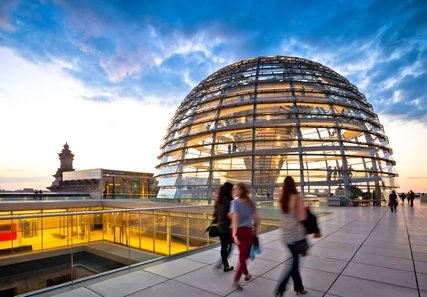
The 23-high glass dome of the Reichstag is a must-see for any visitor to Berlin. Around one million people visit the dome every year, and it offers unparalleled views of the city. An audio guide provides detailed explanations of what you can see as you make your way along the spiral to the top of the dome.
Once at the top, you can take a look into the plenary chamber through the huge glass funnel. The construction of 360 mirrors inside the funnel is impressive, reflecting the sunlight and providing pleasant daylight in the plenary chamber.
When: By appointment
Where: Reichstag, Platz der Republik 1, Mitte
Tip 3: Book a guided tour of the German Bundestag

During a guided tour of the Reichstag building, you will gain an insight into the development of parliamentarianism in Germany and learn exciting facts about the history of the building. Guided tours of the building take place daily and are recommended for young people aged 15 and over.
For younger visitors, special family tours explain the tasks, workings and composition of parliament as well as the history and architecture of the Reichstag building in a child-friendly way. On weekends and public holidays, guided art and architecture tours of the Reichstag Building, Paul Löbe House and Jakob Kaiser House are available. Afterwards, you can visit the Reichstag dome.
You can also register for a visit to a plenary session or for lectures in the visitors' gallery of the plenary chamber.
- To mark Democracy Day,‘insideBundestag’is staging a theatrical experiment at the Ballhaus Prinzenallee on Friday 18 September from 8 pm, where you can experience the rituals and drama of parliamentary life based on the Bundestag minutes from a recent sitting week.
When: Guided tours are only available during non-session times and require prior written registration.
Where: Reichstag, Platz der Republik 1, Mitte

Genießen Sie eine Tour durch das Regierungsviertel und besuchen Sie den Reichstag. Erfahren Sie mehr über Geschichte, Architektur und Politik im Herzen des politischen Berlins. Wollen Sie mehr von Berlin? Schauen & buchen Sie hier!
Tip 4: Discover art and democracy in the government district

The Band of the Federation symbolically connects the formerly divided Berlin. Stroll across the bridge between Paul Löbe House and Marie Elisabeth Lüders House and watch the MPs at work. Enjoy the sunshine on the large open staircase, watch the ships passing by or dance the tango on the terrace in front of the MPs' canteen in summer. Through the glass façade, you can even watch the representatives eating.
Incidentally, a public café is now also in the planning stages. Afterwards, you can stroll along the Spree to Bellevue Palace, the official residence of the Federal President since 1994.
Tip 4: Discover art in the government quarter and Dani Karavan's Grundgesetz 49
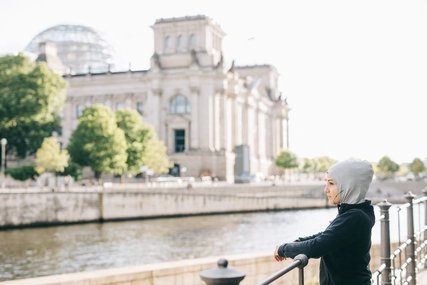
If you walk along the Spree promenade, you will see 19 large panes of glass facing the Jakob-Kaiser-Haus, on which the Israeli artist Dani Karavan has engraved the 19 articles of the German Grundgesetz. Through these first 19 articles of the German Grundgesetz, you can see the House of Parliamentary Groups, where the aim is to ensure that these are upheld in our democracy.
You can find out more about Dani Karavan's Grundgesetz 1949 and other public works of art simply take a walk through the government district in our podcast episode on the transparency of democracy.
When: anytime
Where: Grundgesetz 49, Reichstagsufer 4, Mitte
Tip 5: Try your hand at being a Member of Parliament

How exactly does democracy work? You can find the answer to this question in the "Parliamentary History Exhibition of the German Bundestag" at Deutscher Dom (German Cathedra)l. The journey through the history of parliamentarianism spans four floors and provides insights into history from 1848 to the present day. Key topics include parliamentarianism in the German Empire, the Weimar Republic, the Nazi state and sham parliamentarianism in the GDR, as well as the political new beginning after 1945. On the top floor, you can watch a different film on the topic every day. You can also register for various guided tours and workshops free of charge.
Tip: If you would like to try your hand at being a member of the Bundestag, we recommend the role-playing game "Plenary Session" in the German Cathedral. There is a special room for this, modelled on the original plenary hall in the Reichstag building.
Registration for guided tours and projects: historischeausstellung [at] bundestag.de or by telephone on 030/227-30432 and 030/227-30431
When: Tuesday to Sunday from 10 a.m. to 6 p.m. (May to September 10 a.m. to 7 p.m.)
Where: Deutscher Dom, Gendarmenmarkt 1, Mitte
Tip 6: Experience Europe at the European House
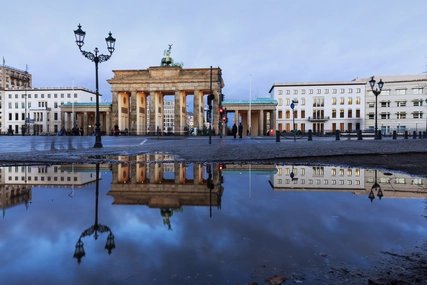
Just a few steps away from the Brandenburg Gate, the exhibition EXPERIENCE EUROPE invites you on a virtual journey through the European Union. Interactive media stations provide interesting facts about European politics and citizen participation in 24 languages. Oe
highlight is the 360° cinema, which immerses visitors in a plenary session of the European Parliament. In addition, groups can take part in exciting role-playing games that simulate European decision-making processes.
When: daily 10 am - 6 pm
Where: Europäisches Haus (European House), Unter den Linden 78, Mitte
Tip 8: Visit the democracy exhibition in the Futurium

Did you know that the idea of democracy is already 2000 years old? The exhibition "Democracy - You can choose the future" at Futurium shows what has changed since then and how democracy can succeed in the future. You can try out for yourself how democracy works in various simulations. Comics draw visionary drafts of democratic societies. And in short videos you can see possible solutions for the future.
In the lab, you can experience the opportunities and risks that new technologies can have for democracy. For example, the "Smile to Vote" voting booth uses AI to determine which party you will vote for based on a quick glance into the camera. Is this fiction or soon-to-be reality? Decide for yourself.
When: Monday to Sunday, 10 am to 6 pm (closed Tuesday).
Where: Futurium, Alexanderufer 2, Mitte.
Tip 9: Set out in search of traces of democracy at historic sites

As well as the government district and the Reichstag, Berlin is home to many other places of democracy, including major landmarks such as St Nicholas’ Church, Zion Church, Alexanderplatz and the Brandenburg Gate – all of which have served as gathering points for democratic movements. It’s not always just about history; current socio-political issues are also discussed there almost daily.
The German Historical Museum, the Humboldt Forum and the district museums regularly host open discussions. And at the Cemetery of the March Martyrs, commemorative ceremonies have been held regularly for almost 175 years in honour of the men and women who once risked their lives to demand freedom and human rights.
If you’re interested in history, why not pop along here on Democracy Day:
- At the‘Post Palast’discussion on 3 September (7–9 pm in Hall 3, ground floor, Humboldt Forum), you’ll have the chance to discuss with editor Angelique Pershon, author Martin Ebendorff-Heidepriem, curator Dominique Falentin and cultural studies scholar Julius L. Jung about how the generation of the 1990s views the Palace of the Republic, the legacy of the GDR and German-German identities.
- In the training session‘Women of the Resistance under National Socialism’on 3 September 2026 (3.00–6.00 pm at the Berlin State Centre for Political Education, Revaler Straße 29, Friedrichshain), you will learn about the biographies of little-known female resistance fighters from Lichtenberg and discuss how the culture of remembrance, controversial street names and historical-political education can be linked.
Tip 10: Visit the Campus for Democracy

A historic site of transformation: the former headquarters of the GDR Ministry for State Security, once a symbol of oppression, is now a‘Campus for Democracy’. Here you can gain fascinating insights into the SED dictatorship and learn interesting facts about the Peaceful Revolution.
- During Democracy Month, you can explore the former central remand prison of the GDR’s Ministry for State Security, with its preserved cells and interrogation rooms, as part of a guided tour on 1 September from 4.40 pm. The tours are led by former political prisoners and historians, who, amongst other things, provide insights into prison conditions and daily life behind bars. Booking is required.
When: 1 September, 4.40 pm – 6.40 pm
Where: Stasi Headquarters. Campus for Democracy, Ruschestraße 103, Lichtenberg
Tip 11: Discover film as a form of resistance
What can cinema tell us when everyday life is shaped by crises? At the open-air cinema at the Fraenkelufer Synagogue on 1 September, you can watch short feature films, animations and TV pitches by students and lecturers from Sapir College in Sderot, near the border with the Gaza Strip.
- The short films showcase the diverse perspectives of these young filmmakers. Among other things, they feature an evacuated resident of Sderot who does not wish to return to his hometown. The autobiographically inspired animation ‘Send Me an Angel’ explores the journey of self-discovery of a transgender girl. And the short film ‘Doll’ tells the story of a mother who sets out in search of her children whilst under rocket fire.
- The subsequent discussion with filmmakers from the university, including director Efrat Corem, will explore what creativity means in times of crisis and the role art can play in fostering resilience and social dialogue.
- Tip: On 8 September from 8 pm, the open-air cinema at the Fraenkelufer Synagogue will be screening Henrika Kull’s film “Südsee”, in which the young German filmmaker Anne and the Israeli actor Nuri grow closer whilst on holiday at Nuri’s parents’ summer house in the mountains between Tel Aviv and Jerusalem.
When: Tuesday, 1 September 2026, 8 pm – 11 pm
Where: Fraenkelufer Synagogue, Friedrichshain-Kreuzberg


