
There are plenty of inspiring exhibitions to see in Berlin in the summer of 2026. Choose whatever takes your fancy from the wide range on offer: the hundred best posters of 2025 from Germany, Austria and Switzerland? Exciting originals from the long-closed collection of the German Historical Museum, or artist C.B. Evans’s topical question ‘Reality Or Not’ on digital entertainment culture? Perhaps you’d like to immerse yourself deeply in the world and culture of skateboarding in Berlin at the special photography exhibition ‘Skaters and skateboarders before and after the fall of the Berlin Wall’? Here are our personal recommendations.
You can find further recommendations and the latest news from Berlin’s museums on our websites:
Museums in Berlin current top exhibitions
Tip 1: Berlin a Thousand Times. The National Gallery Collection at the Hamburger Bahnhof

This exhibition is simply Berlin through and through! It showcases Berlin’s art scene from 1989 to the present day. The focus is on Berlin as a hub of constant social movement and debate, a place where politics, migration, art and protest converge to create a unique way of life. And Berlin as a constant mirror of global events – just think of the division of Germany and the fall of the Wall.
Discover the perspectives and reflections of significant Berlin-based artists at the Hamburger Bahnhof, who explore the city’s myths and trends through sculptures and installations, paintings, drawings and photographs. See more than 70 works that explore subculture, hedonism and many other themes.
When: 12 June 2026 to 30 December 2027
Where: Hamburger Bahnhof – National Gallery of Contemporary Art, Invalidenstraße 50–51, Mitte
Tip 2: Skaters & skateboarders before and after the fall of the Wall
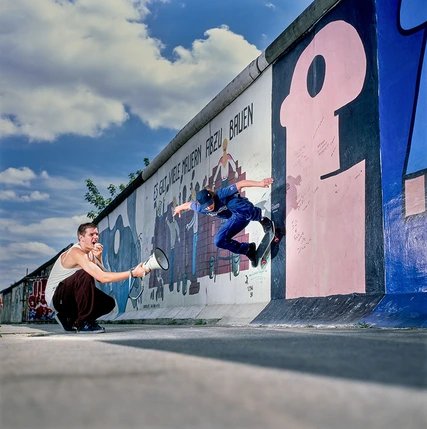
Skateboarding – a way of life! Since the 1970s, skaters in both West Germany and the former GDR have been discovering the cities for themselves: they transform squares and derelict buildings, historic monuments and memorials into stages and ramps for acrobatic adventures. Parks and car parks became social meeting places for the scene.
At the heart of this unusual exhibition are the photographs by ‘Stern’ photographer Harald Schmitt and scene photographers Thomas Kalak and Helge Tscharn; scene clothing, homemade skateboards and many other objects allow you to immerse yourself deeply in this slice of urban culture. Discover how differently the scene developed east and west of the Berlin Wall and where the similarities lay.
When: 10 June 2026 to 4 April 2027
Where: Knaackstraße 97, Prenzlauer Berg
Tip 3: Cassirer and the Breakthrough of Impressionism
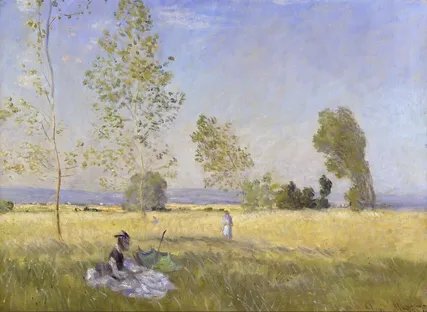
At the turn of the 20th century, an extraordinary gallery owner and art collector, Paul Cassirer, was active in Berlin. You may have heard the name before. Long before the Impressionist art style took Europe by storm, Cassirer began exhibiting and promoting young, and later world-famous, French artists such as Edgar Degas, Paul Cézanne, Édouard Manet, Claude Monet, Auguste Renoir and Vincent van Gogh. He also promoted Max Liebermann, Lovis Corinth and Max Slevogt, and supported Edvard Munch, Ernst Barlach, Ernst Ludwig Kirchner and Paula Modersohn-Becker.
In this way, he not only helped the Impressionists achieve their breakthrough, but also became a patron of Classical Modernism and young avant-garde artists, emerging as the greatest art dealer and patron of his time. You can imagine what spectacular works an art exhibition on Cassirer will feature – it is THE summer exhibition on Museum Island! See around 100 of the most important and famous Impressionist paintings and first-class works of Classical Modernism.
When: until 27 September 2026
Where: Alte Nationalgalerie, Museum Island, Bodestraße, Mitte
Tip 4: 100 Best Posters 25. Germany Austria Switzerland

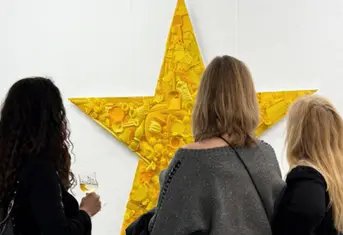
An absolute must for all fans of graphic design: the exhibition of the 100 best posters from Germany, Austria and Switzerland at the Kulturforum in 2025. There you’ll see the most creative and latest single and series posters, with cultural posters dominating the 2,297 entries submitted by 676 studios and designers.
A wide spectrum of design was recognised – from minimalist typography to wildly expressive colour compositions. This year, the jury focused on socially critical messages, presented through bold lettering and vibrant colours. Just as the poster has propagated political content since its inception, you are now also being called upon to protest, show courage and rethink your views.
Don’t miss out on seeing this inspiring exhibition soon, as the posters will be going on tour in early July, including a stop in Korea.
When: 12 June to 5 July 2026
Where: Kulturforum, Johanna-und-Eduard-Arnhold-Platz, Tiergarten
Tip 5: Objects. History. Stories.

You haven’t been able to see the German Historical Museum’s vast collection for many years now, as the historic Zeughaus, where it was housed, is undergoing extensive renovation and modernisation. This situation is set to continue for many years to come. In the meantime, you can visit the German Historical Museum’s fascinating temporary exhibitions on current historical and political issues in the adjacent modern exhibition hall, the Pei Building.
At present, you have the wonderful opportunity to see around 200 fascinating items from the historical collection – which comprises some one million objects – on the ground floor of the Pei Building. Take a stroll through German history, through clearly structured exhibition areas where the exhibits are linked to their broader historical contexts—such as colonialism or National Socialism—and set in contrast to the present day.
Be surprised by an artfully embossed ostrich egg, or admire a magnificent amber board game from 1607, garments belonging to Queen Louise of Prussia, and even a repurposed IKEA bunk bed from a refugee shelter dating from 2015. Incidentally , admission to the DHM is free on 20 June 2026, World Refugee Day, and there is a free themed tour.
When: until 31 October 2026
Where: German Historical Museum, Pei Building, Hinter dem Gießhaus 3, Mitte
Tip 6: Hang on a moment. The Young Bauhaus Festival

Taking a break, having some time out – this isn’t just an issue for us today; even in the world-famous group of artists at the Bauhaus, taking a break played a major role, in keeping with the motto: even the fastest racing bike needs air between its spokes. The Bauhaus artists celebrated, made music and played sport, basking in the sunshine. The conversations and relationships formed during their free time led to new, shared creative ideas.
The Young Bauhaus’s Moment Mal festival invites you to take a break and reflect on it – through artist talks, film screenings, artworks, music and sound installations. In workshops, you can discover new ways to shape your free moments. Come to the Young Bauhaus gathering and switch to pause mode for a few hours.
When: 17 July, 5–9 pm, 18 July, 2 pm–midnight, 19 July, 1–4 pm
Where: The Temporary Bauhaus Archive, Knesebeckstraße 1, Charlottenburg

Tip 7: C.B. Evens: Reality or Not

It’s nothing new: digital media, its ubiquitous entertainment culture and algorithmic systems have a powerful influence on how we perceive things. The Belgian-American artist C.B. Evans has been exploring the structures of the digital world and their impact on our contemporary lives for years.
The Schinkel Pavillon in Berlin’s historic centre is now hosting the artist’s first solo exhibition in Berlin, in which Evans focuses on her film project Reality or Not: A group of school pupils from a Parisian suburb take part in an American producer’s reality show and, in doing so, gradually begin to navigate between different levels of reality, increasingly rejecting their own reality in the process. Watch the moving 35-minute stylistic mix of staged feature film sequences, animations and found footage , and witness the protagonists’ gradual radicalisation.
When: 13 June to 31 August 2026
Where: Schinkel Pavillon, Oberwallstraße 32, Mitte
Tip 8: Art – People – Power. Schönhausen Palace as a crime scene
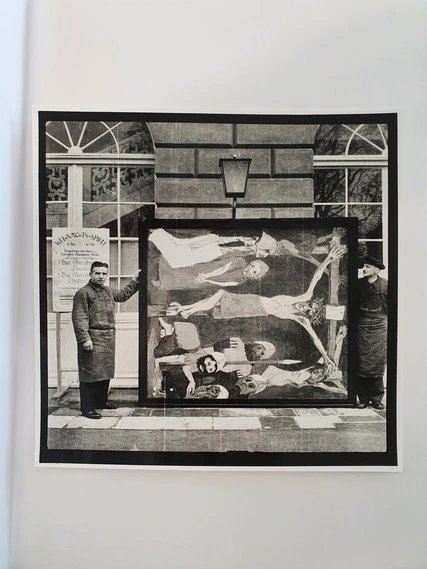
Its situated peacefully amidst greenery, with the palace grounds inviting visitors to take romantic strolls. Nothing suggests that, the former summer residence of the Prussian Queen Elisabeth Christine, played a dark role in the Nazi regime some eighty years ago: Did you know that Schönhausen was used as a central depot for so-called ‘degenerate art’, for masterpieces of Expressionism and modern art? Around 3,750 works of art from all over Germany, which had previously been confiscated by the Nazis, were stored here. From Schönhausen, the artworks were then sold abroad.
See the new exhibition on the site itself , featuring original works and documents. Are you interested in the topic of “degenerate art”? Then find further recommendations for Berlin in the Top Exhibitions 2026.
When: Permanent exhibition from 12 June 2026
Where: Schönhausen Palace, Tschaikowskistraße 1, Pankow
Tip 9: Many Shades of Grès

Marlene Dietrich, Grace Kelly, Greta Garbo and many other international celebrities trusted her when it came to fashion:“Madame Grès”, the celebrated French fashion designer who, from the 1930s onwards, became a pioneer of 20th-century haute couture , created the now-famous long, pleated dresses. These masterpieces, in which several metres of fabric were sometimes gathered into just a few centimetres, were inspired by Greek marble sculpture and were characterised by a timeless, classical elegance .
What makes the exhibition special is not only the presentation of 25 original designs from Mme Grès’s oeuvre – the largest collection outside Paris – but also the fact that these are placed in dialogue with ancient artworks from the Berlin Collection of Classical Antiquities, the Byzantine Museum and the Picture Gallery. In addition, you will see around 150 further exhibits on busts and figurines, in photographs and in projections, which would be inconceivable without Mme Grès’s creations.
When: until 11 October 2026
Where: Museum of Decorative Arts, Kulturforum, Johanna-und-Eduard-Arnhold-Platz, Tiergarten
Tip 10: Edward W. Godwin and Oscar Wilde. Dandy Decadence Modernity

And here’s something special for design enthusiasts: the Bröhan Museum, opposite Charlottenburg Palace, is currently exploring the culture of metropolitan dandyism in the final decades of the 19th century. Two figures stand out in particular from this period: Edward William Godwin (1833–1886) was one of the most radical and influential designers of Victorian England. He shared a close friendship with the writer Oscar Wilde (1854–1900). As a defining figure of his era, Wilde embodied the spirit of Victorian England, straddling the line between dandyism and decadence.
Godwin and Wilde were kindred spirits whose artistic work was shaped by a comprehensive education and an extraordinary thirst for knowledge. Both pursued the ‘ ’ aim of infusing everyday life with aesthetics and transforming it into art. The cult of beauty and the fusion of lifestyle with art and design are the focus of this fascinating exhibition, which also shows you just how much Godwin and Wilde, the leading figures of the Aesthetic Movement, influenced the development of design well into the 20th century.
When: until 30 August 2026
Where: Bröhan Museum, Schloßstraße 1a, opposite Charlottenburg Palace, Charlottenburg
Tip 11: New Woman, New Vision – The Bauhaus Women Photographers

Walter Gropius, Ludwig Mies van der Rohe, Oskar Schlemmer, Marcel Breuer... the names of the artists at the Bauhaus (1919–1930) are world-famous! Get to know the lesser-known women who worked as photographers at the Bauhaus; they were pioneers, courageous and creative! They explored new techniques, developed new perspectives, pushed the boundaries of convention with their art – and contributed to changing the image of women.
The Bauhaus Archive in Berlin, which is unfortunately still closed at present, is exhibiting 300 photographs at the Museum of Photography, including works by female artists from the Institute of Design in Chicago (New Bauhaus), the successor to the Bauhaus in the USA.
When: until 4 October 2026
Where: Museum of Photography, Jebenstraße 2, Charlottenburg


