
Some immediately catch the eye, others only irritate at second glance: Small curiosities in the middle of everyday life, in the centre of the city. Why do pink pipes run across every second street in Berlin? Why do people in Berlin actually live above a motorway? And what are these abandoned places that nobody seems to use anymore, but which still characterise Berlin's cityscape? We have uncovered them - the secrets of Berlin. Because there's always more to Berlin than meets the eye ...
By the way, on visitBerlin.de we have put together numerous other insider tips for Berlin.
Rabbits on Chausseestraße?
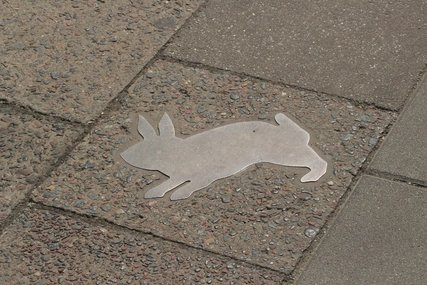
Have you ever noticed the little golden rabbits hopping along Chausseestraße in Mitte? The roughly 50 brass rabbit plaques were created by the artist Karla Sachse in 1999. They were installed on Berlin’s streets to commemorate the death strip between East and West and as a reminder that every political decision affects not only people’s lives but also the animal world.
For the strip of land along the Wall was teeming with life – thousands of urban rabbits lived on the swathe of grass, which was sometimes 100 metres wide, and were walled in when the Wall was built. For years, they were able to munch away undisturbed on the grassy strip, guarded by border guards, high walls and barbed-wire fences. In this microcosm, they multiplied so profusely that they eventually became a nuisance and their tunnels nearly caused the Wall to collapse.
What followed were poisonings, withered grass and an order to shoot the hares. The dramatic story of the Wall hares remains unforgotten to this day. The Oscar-nominated documentary ‘Mauerhasen’ (Wall Hares) chronicled their fate in 2009. And even today, the golden plaques on the streets serve as a reminder of how the Wall changed not only people’s lives forever.
The missing house numbers
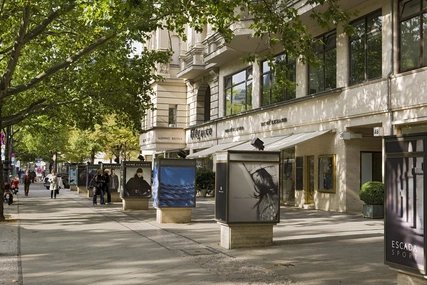
You've probably only noticed this while shopping on Kurfürstendamm if you're looking for a specific house number. House numbers 1 to 10 and 77 to 89 are completely missing. Where have they gone? 1 to 10 fell victim to a street renaming in the 1920s. The fate of numbers 77 to 89 is still unknown today.
Berlin's mysterious "snake"
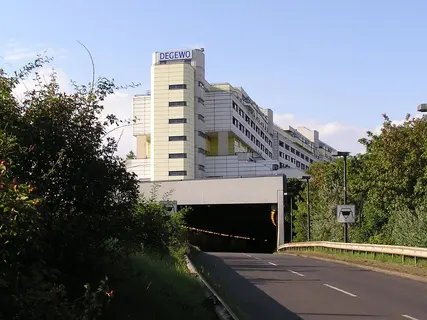
It looks like a typical concrete building from the 1970s - but if you take a closer look (or listen), it becomes clear: A real motorway runs underneath Schlangenbader Straße.
The 600-metre-long residential complex was built above the A104 motorway - due to a lack of space in what was then West Berlin. Over 2,000 flats, terraced houses, landscaped courtyards - and underneath, the traffic rushes by, well insulated in a tunnel.
An extraordinary example of urban planning that still attracts attention today. The "Schlange" has been a listed building since 2017. Even though the tunnel is currently being renovated: This building remains a real piece of Berlin's urban history - and perhaps you will take a closer look next time you go for a walk.
Yoga at Berlin traffic lights

Sometimes we Berliners:Inside dreamily at a traffic light, waiting for the light to turn green and looking around. This is the moment when he unexpectedly makes us smile: the Street Yogi. The little man made of cork and shashlik skewers usually sits on street signs and shows us exercises from hatha yoga. It was invented by sports teacher Josef Foos. Today, there are well over 1,000 street yogis in Berlin - and in addition to yoga, they also play football, climb and knit.
Pink tubes in Berlin's streets
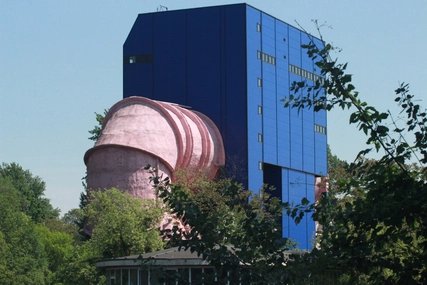
Sometimes we Berliners:inside are also annoyed at a traffic light, wait for the light to turn green and look around. No street yogi makes us smile, but something makes us ponder. Huge pink, sometimes blue tubes hang above many streets. But why are they there? They channel groundwater from construction sites into the Spree. And as there are always construction sites somewhere in Berlin, the pink and blue pipes are very present in the cityscape. And the largest pink pipe is the "TUB circulation channel" at TU Berlin. The pink tube has even become an architectural highlight.
More about architecture in Berlin
Who's that sitting in the Babylon cinema?
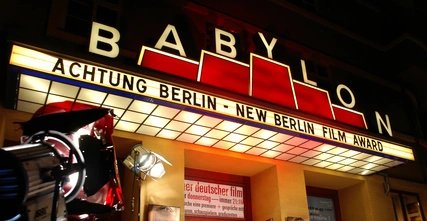
There he sits in the large cinema auditorium of Babylon Babylon, quite far in front and in the middle of the row, taking a leisurely drag on his cigar. It's the legendary Berlin filmmaker Ernst Lubitsch, or rather his statue.
In the 1990s, the figure sat in the Schöneberg cinema Notausgang, which was known for its screenings of screwball comedies and other old films and whose name still makes Berlin cineastes' eyes light up today. After its closure, the statue moved to the Museum of Film and Television and looked out of a window onto the hustle and bustle of the Sony Centre. Now it is back where it belongs - in the cinema.
More about cinemas & film festivals in Berlin
And this quirky building in Steglitz?

And what's the Beer Brush all about? In the centre of Steglitz on the Schloßstraße shopping mile stands a high-rise building in retro-futuristic style. When it opened in 1976 as the Turmrestaurant Steglitz, it was modern and trendy; today its best days are long gone. The 47 metre high tower housed restaurants and pubs, hence the name Bierpinsel. All the tenants have long since left and the reopening is a long time coming. Nevertheless, the former red tower has been shining in a colourful street art look since 2010.


