
For more than 28 years, the Berlin Wall divided the city into East and West. Since the fall of the Wall on 9 November 1989, Berlin has changed fundamentally. Yet if you look closely, you can still spot numerous traces of the former border.
At the famous East Side Gallery, the Wall is now a colourful work of art. At the Berlin Wall Memorial on Bernauer Straße, on the other hand, you’ll gain a particularly striking insight into the history of the division of Germany. And even in surprising places such as the Invalidenfriedhof or Groß Glienicker See, original sections of the Wall have been preserved.
Where did the Berlin Wall used to run, and which sections are still standing today? Find out with visitBerlin’s tips on the last remaining sections of the Berlin Wall.
Tip 1: Marvel at the artworks at the East Side Gallery
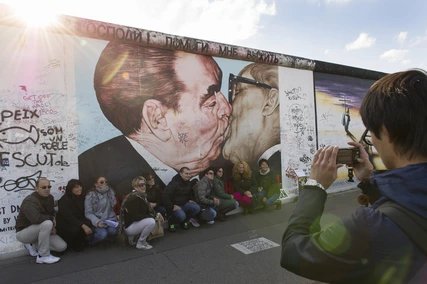
The East Side Gallery is one of Berlin’s best-known attractions and is also the longest surviving continuous section of the Berlin Wall. Over a stretch of around 1.3 kilometres, more than 100 works of art transform the former border fortifications into an impressive open-air gallery. Marvel at the famous ‘brotherly kiss’ between Honecker and Brezhnev or the Trabant that appears to be driving through the Wall.
The images tell of freedom, hope and the political upheavals following the fall of the Wall. Stroll along the River Spree and discover how a symbol of division became one of Berlin’s most famous artistic landmarks!
Where: East Side Gallery, Mühlenstraße 3–100, Friedrichshain
Tip 2: Follow in the footsteps of the fall of the Wall at the Bösebrücke

World history was made here on 9 November 1989! At the former Bornholmer Straße border crossing, the Berlin Wall first opened to the people of East Berlin. Thousands flocked across the Bösebrücke into the western part of the city at that time. Today, an open-air exhibition and traces of the former border fortifications serve as a reminder of this historic moment.
A walk along the former border strip is particularly lovely, where numerous Japanese ornamental cherry trees blossom in spring. They were a gift from the Japanese people t in 1990 as an expression of their great sympathy for a reunified Germany.
Where: Bösebrücke, Bornholmer Straße 70, Prenzlauer Berg
Tip 3: See original sections of the Wall at the Topography of Terror

Right in the heart of Berlin, you can discover a section of the original Berlin Wall around 200 metres long. The border between East Berlin and West Berlin once ran along Niederkirchnerstraße. Today, the preserved section of the Wall stands right next to the Topography of Terror. On this historic site, an exhibition documents the crimes of the Nazi regime. Here, you’ll encounter different chapters of German history all in one place.
Where: Topography of Terror, Niederkirchnerstraße 8, Mitte
Tip 4: Immerse yourself in the history of the Cold War at Checkpoint Charlie

A famous border crossing and the setting for numerous spy thrillers: Checkpoint Charlie is one of the best-known sites associated with the Berlin Wall. The reconstructed border post gives only a glimpse of just how large the former checkpoint actually was.
On large-format posters, you’ll discover historical photos and documentation from the divided city. These include images that made headlines around the world, such as the confrontation between American and Soviet tanks in October 1961. In the coming years, the memorial site is set to be further expanded and redesigned. The focus will be on the history of the Berlin Wall up to its fall and its international repercussions.
Where: Friedrichstraße / corner of Zimmerstraße, Kreuzberg
Tip 5: Experience the division of Berlin at the Berlin Wall Memorial

What did the Berlin Wall, with its heavily guarded border strip, actually look like? The Berlin Wall Memorial on Bernauer Straße gives you a particularly striking impression of this. Parts of the original border fortifications, including a watchtower , have been preserved here.
An open-air exhibition tells the story of escape attempts, separated families and everyday life at the Wall. In the documentation centre, you can delve deeper into the history of the division and look out over the former border strip from a viewing point. Allow plenty of time and discover one of Berlin’s most important historical memorial sites.
Where: Berlin Wall Memorial, Bernauer Straße 111, Mitte
Tip 6: Find hidden remnants of the Wall at the Old Cathedral Cemetery

A historic cemetery as the setting for the division of Berlin? At the Old Cathedral Cemetery of St Hedwig, you’ll discover a lesser-known piece of Wall history. On the northern edge of the cemetery, a section of the former border wall, approximately 15 metres long, has been preserved. An additional concrete wall was also once part of the security defences.
Today, the remains are listed as a historic monument. Amidst old graves and quiet paths, it becomes clear just how deeply the division affected life in the city. Take a detour to Liesenstraße and discover this special place of remembrance off the beaten track.
Where: Old St Hedwig’s Cathedral Cemetery, Liesenstraße 8, Mitte
Tip 7: Combines nature and history in the Groß Glienicke Estate Park

A walk by the water whilst following in the footsteps of the Berlin Wall. This is exactly what you can do in Groß Glienicke Manor Park. During the division of Germany, the border ran right through the middle of Lake Groß Glienicke. The eastern shore was sealed off by border fortifications, whilst people on the West Berlin side were able to use the lake.
Today, preserved sections of the Wall in the Groß Glienicke Estate Park serve as a reminder of this unusual border situation. Discover the historical remnants, enjoy the view of the water and experience how nature and history come together in this special place.
Where: Groß Glienicke Manor Park, Potsdamer Chaussee, Potsdam
Tip 8: Explore the former ‘death strip’ at the Invalidenfriedhof

The Invalidenfriedhof is one of the most extraordinary places where you can still see remnants of the Berlin Wall today. During the division of Germany, a large part of the historic cemetery was destroyed to make way for the expansion of the border fortifications. The GDR’s border security measures required ever more space, and the Invalidenfriedhof was increasingly taken over. In total, over 90 per cent of the graves had to make way for the ‘Death Strip’, including its watchtowers, patrol routes, the running track for the guard dogs and the convoy route . Some sections of the hinterland security wall and the convoy route still serve as reminders of the recent past.
Where: Invalidenfriedhof, Scharnhorststraße 31, Mitte
Tip 9: Enjoy the Berlin way of life in Mauerpark

Where border guards once patrolled, people now gather to make music, relax and party. Mauerpark is a prime example of how Berlin has changed since the fall of the Wall. On the site of the former border strip, you can still see a section of the Hinterland Security Wall today. The wall, covered in graffiti, serves as a reminder of the history of this special place.
It’s also worth a visit on Sundays: then you can combine your historical stroll with a visit to the popular flea market. Explore the park and see how a former border zone has become a vibrant meeting place.
Where: Mauerpark, Bernauer Straße 63–64, Mitte
Tip 10: Feel the past at the Schlesischer Busch

Tucked away between Kreuzberg and Treptow lies a fascinating piece of Berlin Wall history. The border once ran along the flood ditch at Schlesischer Busch. Today, green spaces and footpaths invite you to explore the former border area. Particularly worth seeing is the preserved GDR border watchtower, the former Schlesischer Busch command post.
Painted remnants of the hinterland security wall also serve as a reminder of the city’s division. Here you can see how a strictly monitored border strip has been transformed into an open urban space – it now hosts a variety of exhibitions .
Where: Puschkinallee, Lohmühlenstraße 1, Treptow
Tip 11: Discover the former course of the Wall at Potsdamer Platz

Today, modern high-rises tower skywards all around Potsdamer Platz . It’s hard to imagine that a wide border strip once ran right through the heart of Berlin here. After the fall of the Wall, one of the capital’s best-known new neighbourhoods emerged on this site.
In front of Potsdamer Platz station, original sections of the Wall have been erected to commemorate the era of division. Do also look out for the double row of paving stones on the ground: in numerous places across the city centre, it marks the former course of the Wall.
Where: Potsdamer Platz, Mitte
Bonus: Marvel at forgotten remnants of the Wall in Reinickendorf

You’ve already seen the well-known sights and are looking for more of Berlin’s Wall history? Then it’s worth taking a look at Reinickendorf. On Provinzstraße, around 80-metre-long remains of a former border wall were discovered, which are now listed as a historic monument. The find shows that the history of Berlin’s division still holds surprises, even decades after the fall of the Wall.
Where: Berlin Wall Memorial, Provinzstraße, Reinickendorf


